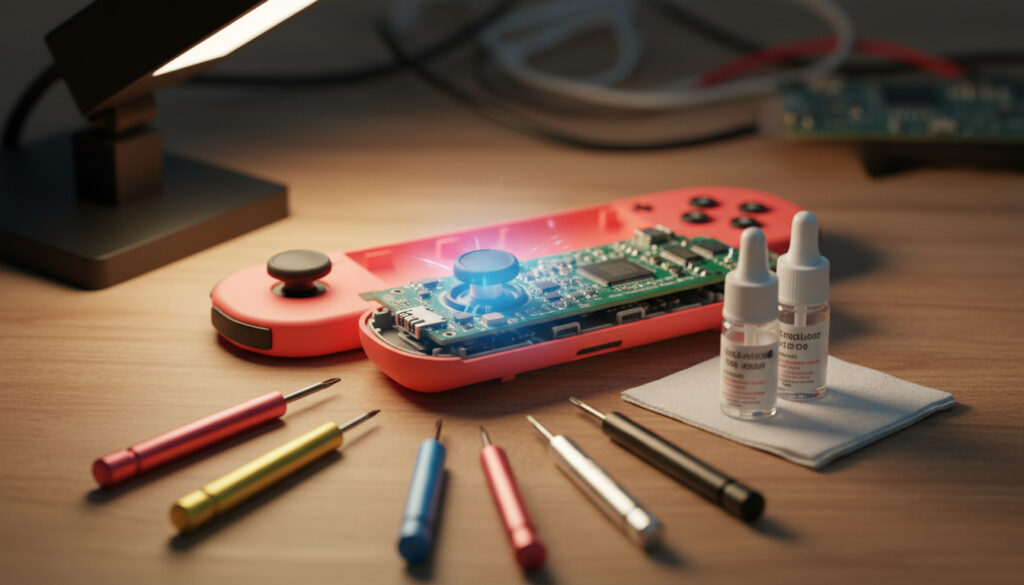
Nintendo Switch Joy Con – Drift Fixes and Repair Guide
Nintendo Switch Joy-Cons represent one of the most innovative yet controversial controller designs in modern gaming. These detachable wireless peripherals introduced HD Rumble and motion controls to the hybrid console when it launched in March 2017, but persistent hardware failures have generated thousands of consumer complaints and multiple class-action lawsuits.
The analog stick drift issue—where controllers register movement without physical input—has affected the standard Switch, Switch Lite, and OLED models alike. Despite Nintendo offering repair programs and formal apologies, no permanent hardware revision has eliminated the defect from existing hardware iterations.
This guide examines what Joy-Cons are, why they fail, and how owners can address drift through official channels, DIY methods, or third-party alternatives.
What Are Nintendo Switch Joy-Cons?
Detachable left/right controllers featuring HD Rumble haptic feedback, IR motion camera, and NFC amiibo support.
Function with all Switch models—standard, OLED, and Lite (in handheld mode)—using Bluetooth or direct attachment.
Analog stick drift from hardware wear, documented since 2017 and affecting gameplay across all titles. See our Nintendo Switch Joy Con – Drift Fixes and Repair Guide for detailed troubleshooting.
Official pairs retail for approximately $79.99 USD, with individual replacements available for $49.99.
Key Insights
- Hardware wear causes analog sticks to drift in units worldwide, with epidemic reports emerging by 2019.
- Nintendo issued a formal apology in 2020 via president Shuntaro Furukawa, acknowledging consumer frustration.
- DIY repairs using magnetic Hall Effect sticks offer drift-resistant alternatives but potentially void official free repair eligibility.
- Switch Lite and OLED models utilize identical analog stick designs, inheriting the same vulnerabilities despite hardware revisions.
- Free repairs remain available in the EEA, UK, and Switzerland regardless of warranty status or proof of purchase.
- US class-action litigation has moved to private arbitration without public settlement details as of 2025.
Technical Specifications
| Feature | Details |
|---|---|
| Release Date | March 2017 |
| Weight | 102g each (approximate) |
| Battery Life | 20 hours playtime |
| Warranty | 12 months limited |
| Connectivity | Bluetooth 3.0 / Wired USB-C |
| Sensors | Accelerometer, Gyroscope |
| Special Features | HD Rumble, IR Camera, NFC |
| MSRP | $79.99 per pair |
Why Do Joy-Cons Drift and What Causes It?
What Causes Joy-Con Stick Drift?
Drift occurs when analog sticks detect input without physical contact, typically manifesting as unwanted camera movement or character direction changes. The phenomenon stems from hardware wear inside the stick module, specifically friction-related degradation of internal components, though Nintendo has not confirmed the exact technical mechanism.
Users reported drift even without heavy use, with epidemic levels documented in 2019 affecting competitive titles like Super Smash Bros. Ultimate and Splatoon 2. The original stick design has persisted across all hardware revisions, from the 2019 Switch Lite to the 2021 OLED model, indicating no fundamental hardware fix in existing product lines. Analysis of hardware design
Nintendo has not publicly confirmed the precise mechanical failure causing drift, though internal friction and component wear are widely documented by repair technicians and affected users.
What Is the Joy-Con Drift Lawsuit?
Class-action litigation began in July 2019 when plaintiff Ryan Diaz filed suit in Seattle under the Magnuson-Moss Warranty Act, citing financial injury from defective controllers. The case expanded to include Switch Lite owners and a child plaintiff, alleging that defects reduce product value and that replacement controllers often develop identical issues within weeks.
Nintendo president Shuntaro Furukawa issued a public apology in 2020 for the “inconvenience” caused by drift issues, though the company cited ongoing litigation when pressed for technical explanations. US cases have since moved to compulsory arbitration, preventing public trials, with no settlements or damages awarded detailed in available court records through 2026. Legal filings and controversy details Official apology coverage Additional lawsuit analysis
How to Fix Joy-Con Drift
Is There a Joy-Con Drift Fix Without Repair?
Nintendo recommends several troubleshooting steps before submitting hardware for repair. Owners should first verify controllers attach correctly via the HOME Menu’s Controllers screen, then update both console firmware and Joy-Con controller firmware to current versions. Removing any skins or protective covers allows proper calibration through system settings.
Software updates occasionally mitigate drift temporarily. Version 13.0.0 introduced calibration adjustments that reduced symptoms for some users, though effects typically prove non-permanent. For specific titles like Mario Kart 8 Deluxe, disabling tilt controls or updating game software may reduce apparent drift symptoms. Official troubleshooting steps
Official Repair Programs
Nintendo offers free repairs for drift—termed “responsiveness syndrome”—in the European Economic Area, United Kingdom, and Switzerland. This policy applies regardless of warranty status, wear and tear, or proof of purchase, excluding only cases involving physical damage, unauthorized modifications, or commercial use.
In the United States, free out-of-warranty repairs emerged following 2019 litigation, replacing earlier policies that charged approximately $40 plus shipping for drift-related repairs. The current US status remains less clearly defined than European policies, with eligibility varying by individual case assessment.
Consumers in the EEA, UK, and Switzerland qualify for no-cost drift repairs indefinitely “until further notice,” regardless of when they purchased the hardware or whether they have receipts.
Best Replacements for Joy-Con Sticks
Third-party Hall Effect sticks utilize magnetic sensors rather than physical contact points, theoretically eliminating drift caused by friction wear. These components require soldering and technical skill to install, and Nintendo warns that unauthorized modifications may void eligibility for official free repair programs. Replacement Joy-Con pairs serve as temporary solutions, though new units remain susceptible to the same hardware wear over time.
How to Sync, Calibrate, and Charge Joy-Cons
How Do You Sync Joy-Cons to Switch?
Proper registration occurs automatically when Joy-Cons slide onto the console rails while powered on. For wireless pairing or troubleshooting connection issues, users can access the Controllers screen from the HOME Menu to verify recognition. Persistent attachment failures require consultation of separate Nintendo hardware guides for physical alignment issues.
How to Calibrate Joy-Con Sticks?
Calibration requires navigating to System Settings > Controllers and Sensors > Calibrate Control Sticks. Users must remove any protective skins or covers before beginning the process to ensure accurate dead-zone detection. The procedure involves following on-screen prompts to rotate sticks fully and center them, with results testable immediately in the calibration interface. Technical documentation
How to Charge Joy-Cons?
Joy-Cons charge automatically when attached to a powered Nintendo Switch console or when docked with an official charging grip. A full charge provides approximately 20 hours of continuous gameplay. No specific charging anomalies correlate with drift issues, though depleted batteries may cause temporary connectivity interruptions mistaken for hardware failure.
For optimal battery longevity, avoid leaving Joy-Cons attached to an unpowered console for extended periods, as this may slowly drain charge without providing replenishment.
Games like Kirby and the Forgotten Land – Guide, Reviews, Switch 2 Edition demonstrate the precise control required for platforming titles where drift significantly impacts gameplay experience.
Timeline of Joy-Con Development and Drift Issues
-
: Nintendo Switch launches with detachable Joy-Controllers; isolated drift reports begin appearing within months.
— Launch reports -
: Ryan Diaz files class-action lawsuit in Seattle; media documents epidemic-level failure rates.
— Litigation begins -
: Switch Lite releases with integrated controllers; later added to existing lawsuits as drift affects new hardware.
— Lite addition -
: Nintendo President Shuntaro Furukawa publicly apologizes for drift-related inconvenience during shareholder briefing.
— Official apology -
: Switch OLED model launches; hardware analysis confirms identical analog stick modules to original 2017 design.
— OLED teardown -
: Free repair programs continue in select regions; no confirmed hardware revision or Switch successor details released addressing stick redesign.
— Current policy
What We Know and What Remains Uncertain
| Established Information | Information Remaining Unclear |
|---|---|
| Analog stick drift stems from internal hardware wear and friction within the control module mechanism. | The precise technical cause of premature component degradation remains unconfirmed by Nintendo engineers. |
| All Switch models (Standard, Lite, OLED) use interchangeable Joy-Cons susceptible to identical drift issues. | Whether future hardware generations will implement magnetic Hall Effect sticks or other permanent redesigns. |
| Free repair programs operate in EEA nations, UK, and Switzerland indefinitely; US previously offered similar programs post-litigation. | Long-term durability of firmware calibration fixes and replacement sticks under normal gaming conditions. |
| US class-action cases have entered binding arbitration without public disclosure of settlements or admissions of defect. | Final legal resolution or potential compensation for consumers outside arbitration jurisdictions. |
The Broader Context of Joy-Con Hardware
The detachable Joy-Con design enabled the Switch’s hybrid identity, allowing seamless transition between portable handheld and docked television modes while facilitating local multiplayer through shared controllers. Features like HD Rumble—the haptic technology capable of simulating precise textures like ice cubes in a glass—demonstrated hardware innovation that distinguished the platform from competitors.
However, the reliability crisis has undoubtedly impacted consumer trust in Nintendo’s hardware quality. The persistence of identical stick designs across the 2019 Switch Lite and 2021 OLED revisions suggests either technical constraints or cost considerations prevented immediate remediation. Third-party manufacturers have capitalized on this gap, offering Pro Controllers and magnetic stick modules as alternatives, though none replicate the full feature set of official Joy-Cons.
Statements from Nintendo and Legal Filings
“We apologize for any inconvenience caused to our customers regarding this matter. We are continuing to improve our products, but since the lawsuit is still ongoing, we cannot comment further.”
— Shuntaro Furukawa, Nintendo President, 2020
The July 2019 complaint alleged violations of the Magnuson-Moss Warranty Act and state consumer protection laws, citing financial injury from controllers that “fail to perform as reasonably expected” and “reduce the value of the product.”
— US District Court filings, Western District of Washington
Summary
Nintendo Switch Joy-Cons remain essential to the console’s modular design despite widespread analog stick drift stemming from hardware wear documented since 2017. While Nintendo provides free repairs in European markets and has apologized for the inconvenience, no permanent hardware solution exists for current models. Users experiencing drift should attempt calibration and firmware updates before pursuing official repair channels or considering third-party alternatives like Kirby and the Forgotten Land – Guide, Reviews, Switch 2 Edition compatible controllers.
Frequently Asked Questions
How long do Joy-Con batteries last on a full charge?
Joy-Cons provide approximately 20 hours of continuous gameplay when fully charged, according to technical specifications. Charging occurs automatically when attached to a powered console or charging grip.
What is HD Rumble in Joy-Cons?
HD Rumble is a haptic feedback technology utilizing linear actuators to create precise vibration sensations, such as simulating the feeling of individual ice cubes colliding in a glass.
Can I get Joy-Cons repaired for free if warranty expired?
Yes, in the EEA, UK, and Switzerland, Nintendo repairs drift issues free regardless of warranty status or purchase date. US eligibility varies based on case review and litigation history.
What are Hall Effect joysticks?
Hall Effect sticks use magnetic sensors rather than physical potentiometers to detect movement, eliminating friction-based wear that causes traditional drift, though they require technical installation.
How much did Nintendo charge for drift repairs before 2019?
Prior to expanding free repair policies, Nintendo charged approximately $40 USD plus shipping for out-of-warranty Joy-Con repairs in the United States.
Does the Switch OLED have fixed Joy-Cons?
No, the Switch OLED utilizes identical analog stick modules to previous models and remains susceptible to the same drift issues, according to hardware analysis.
More related posts
 Wesley Plaisier: Career, Rankings, and Personal Life (2025)
 Blood Types: Rarity, Compatibility, and Key Facts
 Kirby and the Forgotten Land – Guide, Reviews, Switch 2 Edition
 Warner Bro Studio Tour: Hollywood v London Guide
 Chase DeMoor: From Reality TV to Boxing Record & Net Worth
 Holy Island Tide Times: Safe Crossing Times Today
 Sienna Spiro: Ethnicity, Voice, Neurodivergence & Hit Song
 Google Search by Image: How to Reverse Search Pictures
