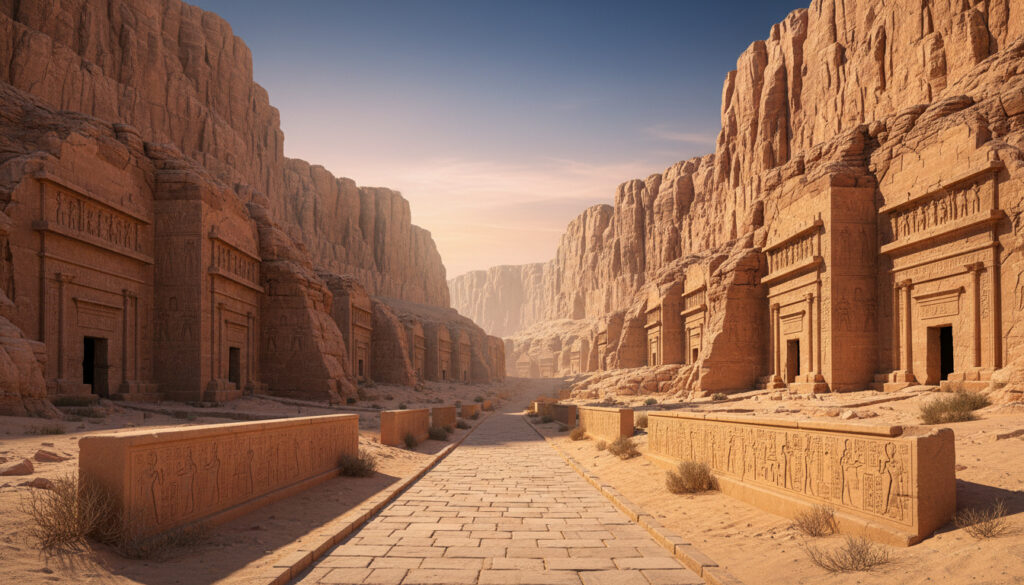
Valley of the Kings – Map, History and 2025 Guide
The Valley of the Kings stands as Egypt’s most celebrated burial ground, a UNESCO World Heritage Site since 1979 where New Kingdom pharaohs sought eternal concealment. Located on the West Bank of the Nile near modern Luxor, this barren wadi served as the final resting place for rulers from the Eighteenth through Twentieth Dynasties, spanning nearly five centuries from approximately 1539 to 1075 BCE. Archaeological records indicate the valley contains at least 63 rock-cut tombs.
Unlike their pyramid-building predecessors, these pharaohs commissioned rock-cut tombs designed to evade the grave robbers who had plagued Egypt’s visible monuments. Architect Ineni carved the first burial chamber for Thutmose I, initiating a tradition that would see dozens of tombs excavated into the valley’s limestone cliffs. Despite elaborate concealment efforts, nearly every tomb suffered looting in antiquity, with KV62 of Tutankhamun remaining the sole near-intact royal discovery.
Today, the site draws over two million visitors annually who navigate narrow passages decorated with intricate mythological scenes depicting the journey through the Duat. The Theban Mapping Project continues to document new findings while conservation teams work to preserve the delicate wall paintings from humidity and human traffic.
What Is the Valley of the Kings?
West Bank of Nile, Luxor
1539–1075 BCE (New Kingdom)
63 known, 20+ pharaohs
Part of Ancient Thebes
- The KV numbering system, established by British Egyptologist John Gardner Wilkinson in the 19th century, catalogs each tomb sequentially by discovery.
- Only pharaohs from the 18th through 20th Dynasties utilized this necropolis, marking a distinct shift from the earlier pyramid-building traditions of the Old and Middle Kingdoms.
- Tombs were rock-cut rather than constructed, with workers channeled through specialized villages like Deir el-Medina.
- Architects designed bent-axis corridors to symbolize the sun’s setting and the soul’s journey westward.
- Professional tomb robbers cleared nearly all burial chambers within centuries of closure, leaving only scattered artifacts and damaged sarcophagi.
- Wall decorations feature the Amduat and other funerary texts guiding the deceased through the underworld.
- Modern archaeological efforts began in earnest during the late 18th century and continue today with projects like the search for KV63.
| Attribute | Details |
|---|---|
| Discovery | Known to locals since 16th century; scientific exploration began late 18th century |
| Tutankhamun Find | November 4, 1922 by Howard Carter |
| Size | Approximately 10 km² with 200+ shafts |
| Notable Pharaohs | Ramses II, Seti I, Thutmose III, Tutankhamun |
| Visitor Statistics | 2 million+ annually |
| Coordinates | 25°44′27″N 32°36′8″E |
| Current Status | Active archaeological site with rotating tomb access |
Where Is the Valley of the Kings and How to Get There?
Exact Location and Coordinates
The necropolis sits on the West Bank of the Nile at coordinates 25°44′27″N 32°36′8″E, south of the pyramid fields of earlier dynasties. Geographic surveys place this location across the river from ancient Thebes, positioning the dead in the symbolic realm of the setting sun and the underworld god Osiris.
Getting There from Luxor
Travelers cross the Nile via ferry or taxi from Luxor’s East Bank, a journey of roughly 20 to 30 minutes depending on traffic and boat schedules. Upon arrival at the West Bank, visitors proceed to a modern visitor center where electric trams transport ticket-holders into the valley itself. What Is a Corn on Your Foot provides medical context for foot conditions, though proper footwear remains essential for navigating the rocky desert terrain.
Opening Hours and Best Time to Visit
Operating hours typically run from 6 AM to 5 PM, though seasonal adjustments occur during peak summer months when extreme heat prompts earlier closures. Visitor documentation confirms that timing impacts both crowd density and physical comfort.
Arrive before 9 AM to avoid both crowds and the worst of the desert heat. October through April brings the busiest tourist traffic; mid-week visits offer thinner crowds. Summer temperatures regularly exceed 40°C (104°F), making hydration and sun protection essential.
History and Timeline of the Valley of the Kings
The Shift from Pyramids
Thutmose I, ruling circa 1493–1482 BCE, broke with millennia of tradition by commissioning architect Ineni to excavate a hidden tomb rather than building a visible pyramid. Historical records indicate this strategic concealment aimed to protect royal remains from the systematic looting that had plagued pharaonic burials since the Old Kingdom.
Peak Period and Architectural Evolution
The Late 18th and 19th Dynasties saw tombs grow increasingly elaborate. Pharaohs like Amenhotep II, Thutmose III, Seti I, and Ramses II commissioned multi-chambered complexes extending deep into the bedrock. Early bent-axis designs gave way to linear corridors filled with detailed renderings of the Amduat, Book of Gates, and other guides to the afterlife.
Decline and Abandonment
By the 20th Dynasty (circa 1189–1075 BCE), tomb construction declined in quality as the state faced economic pressures. By this period’s end, professional thieves had breached nearly every known burial, prompting royal officials to periodically consolidate and re-bury mummies in hidden caches.
Famous Tombs and Key Discoveries
KV62 and the Tutankhamun Discovery
Howard Carter’s 1922 discovery of KV62 transformed archaeological understanding of New Kingdom burial practices. Working under the patronage of Lord Carnarvon and serving as Chief Inspector of Upper Egypt, Carter uncovered the tomb’s entrance on November 4, 1922. Carter’s records describe the moment he first peered inside, revealing treasures despite ancient robbers having breached the antechamber.
KV5 and Other Major Finds
KV5, the tomb of Ramses II’s numerous sons, stands as the largest complex in the valley. Discovered in 1995 but not open to the public, it contains over 120 chambers on multiple levels. Insta360 Ace Pro 2 technology has enabled modern documentation of such complex structures, though visitors cannot access this particular site.
KV62 requires a separate admission fee, typically equivalent to $10-15 USD, due to its significance and the need for crowd control. The Theban Mapping Project provides detailed plans of open tombs, allowing visitors to preview layouts before navigating the narrow passages.
Tombs feature steep staircases, low ceilings, and narrow corridors unsuitable for those with mobility limitations or claustrophobia. General admission tickets permit entry to three tombs of the visitor’s choice from available options, with staff rotating access to allow periodic restoration.
When Was the Valley of the Kings Used?
- : Thutmose I becomes the first pharaoh buried in the valley, establishing the necropolis.
- : Hatshepsut commissions the first identified pharaoh’s tomb with detailed decoration.
- : Tutankhamun receives burial in the modest KV62, sized for his brief reign.
- : Final royal burials occur as the 20th Dynasty ends and the New Kingdom collapses.
- : Napoleon’s expedition maps the valley, initiating modern archaeological interest.
- : John Gardner Wilkinson establishes the KV numbering system still used today.
- : Howard Carter discovers the steps leading to KV62.
- : UNESCO inscribes the Valley of the Kings as part of the Ancient Thebes World Heritage Site.
- : Kent Weeks uncovers the massive KV5 tomb complex.
- : Excavations reveal KV63, containing embalming supplies rather than a burial.
What Do Archaeologists Know for Certain?
- 63 tombs are cataloged in the KV system.
- Thutmose I initiated the valley’s use circa 1493 BCE.
- Only KV62 remained substantially unlooted until modern times.
- The site served exclusively New Kingdom royalty (18th–20th Dynasties).
- Howard Carter discovered Tutankhamun’s tomb in 1922.
- The exact number of undiscovered tombs remains unknown.
- Some tomb attributions, such as KV20 for Thutmose I versus Hatshepsut, lack definitive proof.
- The identity of specific tomb robbers and the precise timing of ancient looting incidents.
- Whether additional chambers lie hidden behind KV62’s decorated walls.
Why Did Pharaohs Choose This Valley?
The valley’s selection marked a theological and strategic revolution. Architects abandoned the conspicuous pyramids of the north for concealed rock-cut chambers in this secluded wadi, chosen for its proximity to the sacred peak of al-Qurn and its position in the western desert—the realm of the dead and the setting sun.
This relocation reflected evolving beliefs about the afterlife journey. Documentary evidence shows tombs decorated with the sun god Ra’s nightly passage through the underworld (Duat), with the pharaoh joining this cosmic cycle. The bent-axis design of early tombs physically replicated the sun’s descent, while later linear tombs streamlined this spiritual path.
The concentration of royal burials in one valley also facilitated protection, though ultimately unsuccessful, by allowing guards to monitor a single discreet location rather than scattered pyramid complexes across the desert.
Who Documented the Valley’s Secrets?
“At first I could see nothing… but presently, as my eyes grew accustomed to the light, details of the room within emerged slowly from the mist, strange animals, statues, and gold—everywhere the glint of gold.”
— Howard Carter, describing the first view into Tutankhamun’s tomb, November 26, 1922
“The Valley of the Kings represents the most magnificent collection of tombs in Egypt, revealing the full flowering of New Kingdom funerary art and belief.”
— Theban Mapping Project documentation
Is the Valley of the Kings Worth Visiting?
The Valley of the Kings delivers an unmatched encounter with ancient Egyptian civilization, offering access to decorated chambers where pharaohs orchestrated their eternal journeys. While the crowds and heat present challenges, the opportunity to stand within KV62 where Carter found “wonderful things” or to examine the detailed reliefs in Seti I’s tomb justifies the journey across the Nile. Visitors should prepare for physical demands, budget for the separate KV62 admission, and prioritize early morning arrivals to experience these millennia-old chambers in relative solitude.
Frequently Asked Questions
Is the Valley of the Kings worth visiting?
Yes, particularly for those interested in ancient history. It contains the only nearly intact pharaoh’s tomb ever found (Tutankhamun) and displays sophisticated New Kingdom artwork despite most burials having been looted.
What are the current opening hours?
The site typically operates from 6 AM to 5 PM, though hours shorten during peak summer heat. Visitors should confirm current times locally as seasonal adjustments occur.
How much do tickets cost?
A general admission ticket covering three tombs costs approximately 260 Egyptian pounds (subject to change), with KV62 requiring an additional fee roughly equivalent to $10-15 USD.
Why is it called the Valley of the Kings?
The name derives from its function as the principal burial ground for New Kingdom pharaohs, Arabic “Wadi el-Muluk” (Valley of the Kings), distinguishing it from the nearby Valley of the Queens.
Can you take photographs inside the tombs?
Photography is prohibited inside most tombs to preserve the delicate wall paintings from flash damage and humidity. Some exterior areas allow cameras.
Which tombs should I prioritize?
Seti I (KV17) offers the finest artwork, while Ramses VI (KV9) features well-preserved astronomical ceilings. Tutankhamun (KV62) requires extra admission but provides historical significance despite modest size.
More related posts
 A5 Size in CM – Exact 14.8 x 21 cm Dimensions
 Terry Crews: NFL Career, Net Worth, Wife, and LGBTQ+ Advocacy
 Anthony Edwards: Height, Baby Mamas, and Relationship Facts
 Wicked One Wonderful Night: Where to Watch, Cast & Details
 Gareth Pierce: Real Life, Age, Wife, and Career
 BBC Weather 14 Day Forecast for the UK and Ireland
 Prince of Wales Theatre: Seats, Tube, Dress Code & Shows
