When Do the Clocks Change 2025 – UK, US and EU Dates
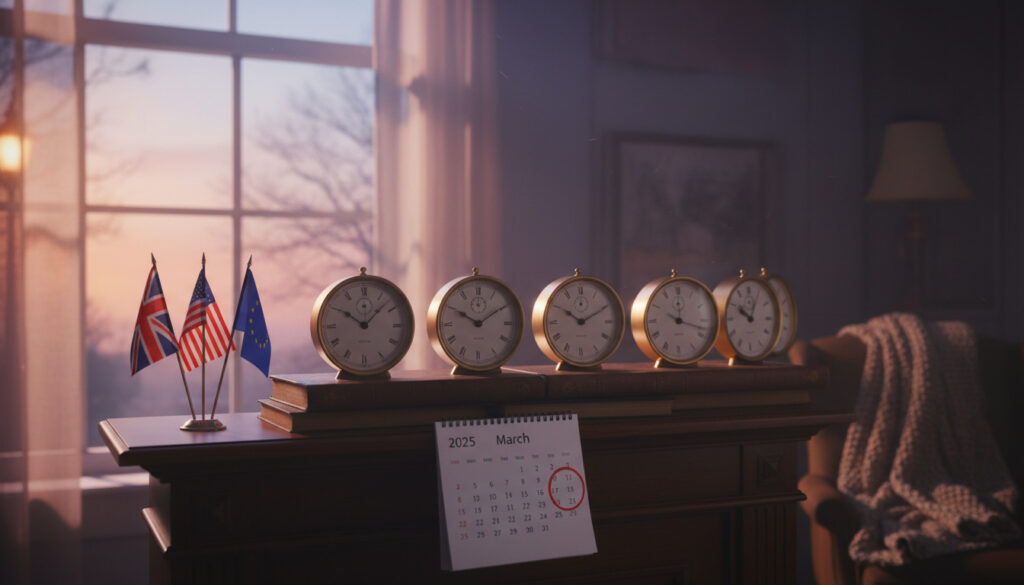
The transition between standard time and daylight saving time arrives twice yearly, and 2025 brings specific dates that vary significantly by region. Most of the United States will adjust clocks on March 9 and November 2, while the United Kingdom and European Union member states follow different schedules on March 30 and October 26. These shifts impact sleep patterns, international coordination, and daily routines for billions of people worldwide.
Understanding the precise timing and direction of these changes helps prevent missed appointments and confusion. While digital devices often update automatically, manual clocks require attention to avoid running an hour early or late during the transition periods.
This guide provides the confirmed 2025 dates for major regions, explains the mechanics of springing forward and falling back, and clarifies which jurisdictions opt out entirely.
When do the clocks go forward in 2025?
The spring transition marks the beginning of daylight saving time across the Northern Hemisphere. Clocks advance by one hour, shifting daylight from morning to evening.
- The United Kingdom and European Union advance clocks on the last Sunday in March, specifically at 1:00 a.m. UTC, moving from Greenwich Mean Time to British Summer Time.
- The United States begins Daylight Saving Time three weeks earlier on the second Sunday in March, with clocks jumping forward at 2:00 a.m. local time on , according to CBS News.
- When clocks spring forward, communities lose one hour of sleep but gain extended evening daylight.
- Arizona (excluding the Navajo Nation), Hawaii, and several U.S. territories do not observe these changes, maintaining standard time year-round.
- All EU member states switch simultaneously at 1:00 a.m. UTC, regardless of local time zone differences, as documented by Wikipedia.
- The concept originated in Germany during 1916 as an energy conservation measure during World War I, as reported by CBS News.
- Approximately 30 U.S. states have proposed legislation to change their DST practices since 2015, though federal law currently prevents permanent adoption without congressional approval.
| Location | Forward Date/Time | Back Date/Time | Rule |
|---|---|---|---|
| United Kingdom | 30 March, 1:00 a.m. UTC | 26 October, 1:00 a.m. UTC | Last Sunday March/October |
| United States (most) | 9 March, 2:00 a.m. local | 2 November, 2:00 a.m. local | 2nd Sunday March, 1st Sunday November |
| European Union | 30 March, 1:00 a.m. UTC | 26 October, 1:00 a.m. UTC | Last Sunday March/October |
| Australia (most states) | 5 October, 2:00 a.m. | 6 April, 3:00 a.m. | 1st Sunday October/April |
| New Zealand | 28 September, 2:00 a.m. | 6 April, 3:00 a.m. | Last Sunday September, 1st Sunday April |
| Israel | 28 March, 2:00 a.m. | 26 October, 2:00 a.m. | Friday before last Sunday March |
| Egypt | 25 April, 00:00 | 30 October, 24:00 | Last Friday April, Last Thursday October |
When do the clocks go back in 2025?
Autumn Transitions in Europe and the UK
British Summer Time concludes on . At 1:00 a.m. UTC, clocks return to 1:00 a.m. Greenwich Mean Time, effectively repeating the hour between 1:00 a.m. and 2:00 a.m. This aligns with European Union practices, which the UK maintained post-Brexit.
Ending DST in the United States
The United States reverts to standard time on at 2:00 a.m. local time, when clocks fall back to 1:00 a.m. This creates an extra hour of sleep but reduces evening daylight. The scheduling follows the Uniform Time Act of 1966, as noted by Economic Times.
When clocks fall back in October and November, sleepers gain one additional hour overnight. The UK change occurs at 1:00 a.m. UTC on 26 October, returning to Greenwich Mean Time, while the US transition happens at 2:00 a.m. local time on 2 November.
Daylight Saving Time 2025 in the UK
British Summer Time Explained
The UK switches to British Summer Time (BST) on 30 March 2025, advancing from Greenwich Mean Time (GMT) to GMT+1. This shift applies nationwide, affecting England, Scotland, Wales, and Northern Ireland simultaneously. The change occurs at 1:00 a.m. UTC, when clocks move forward to 2:00 a.m. BST.
Alignment with European Neighbours
Despite leaving the European Union, the United Kingdom continues to follow the same seasonal time change dates as EU member states. This coordination facilitates trade, travel, and communication across the channel. The simultaneous switch at 1:00 a.m. UTC ensures no time difference emerges between London and Paris or Berlin during the transition.
For those interested in how time zones affect property markets across regions, see Houses for Sale Belfast – Prices, Areas and Trends 2025.
DST Changes in the US 2025
The Uniform Time Act Framework
Federal law establishes the starting and ending dates for daylight saving time in the United States. The 1966 legislation standardized the dates to the second Sunday in March and the first Sunday in November, replacing previous state-by-state variations. States may exempt themselves from observing DST, but cannot adopt permanent DST without congressional action.
States That Opt Out
Arizona, Hawaii, and five U.S. territories remain on standard time throughout 2025. The Navajo Nation, which extends into Arizona, does observe DST, creating a time zone enclave within the state. This exception generates unique scheduling challenges for businesses and residents near tribal borders.
While the Senate passed legislation in 2022 to make DST permanent, the bill stalled in the House of Representatives. As of 2025, a renewed push by 16 senators continues, but without federal legislative change, states cannot unilaterally adopt permanent DST, according to Economic Times.
The Navajo Nation within Arizona does observe DST, creating time differences with the rest of the state during summer months. Additionally, territories including American Samoa, Guam, Northern Mariana Islands, Puerto Rico, and the US Virgin Islands remain on standard time year-round, as confirmed by CBS News.
The Complete 2025 Clock Change Calendar
- : United States clocks spring forward (DST begins)
- : Israel clocks spring forward
- : UK and EU clocks spring forward to summer time
- : New Zealand clocks spring forward
- : Australia clocks spring forward
- : UK and EU clocks fall back to standard time
- : United States clocks fall back (DST ends)
What We Know for Certain About 2025
Established Information
- UK clocks change 30 March and 26 October at 1:00 a.m. UTC
- US clocks change 9 March and 2 November at 2:00 a.m. local time
- EU maintains last Sunday of March/October schedule
- All shifts advance or retreat by exactly one hour
- Arizona (except Navajo Nation) and Hawaii do not observe DST
Information Remaining Unclear
- Whether the US Senate’s 2025 push for permanent DST will reach a House vote
- Potential future EU discontinuation of seasonal changes
- Specific implementation timelines if federal US law changes
- Whether UK will diverge from EU dates in future years
Why Do We Change the Clocks?
Germany introduced daylight saving time in 1916 to conserve coal during World War I. The practice spread rapidly through Europe and North America, intended to reduce evening energy consumption by extending daylight hours. While the original energy savings rationale remains debated, the temporal tradition persists across much of the industrialized world.
Global adoption varies significantly. Most countries near the equator do not observe DST, as daylight hours remain relatively constant year-round. Nations including Japan, India, and China maintain standard time throughout the year. Recent years have seen movements to abolish the practice, with the European Commission proposing an end to seasonal changes, though implementation remains pending.
For context on how terminology evolves across different fields, see What Does Cis Mean – Guide to Gender, Chemistry, Geopolitics.
Official Timekeeping Sources
Most countries observe DST or summer time for 1 hour (some 30 minutes), but many do not; US and Europe are exceptions among global norms.
Governed by the Uniform Time Act of 1966; states can opt out but not adopt permanent DST without federal approval.
— CBS News
EU Summer Time starts last Sunday in March at 1:00 a.m. UTC and ends last Sunday in October at 1:00 a.m. UTC. All time zones change simultaneously.
Key Takeaways for 2025
Prepare manually for the UK clock change on 30 March and 26 October, and the US changes on 9 March and 2 November. Smartphone and computer users generally need not intervene, as devices update automatically based on network time protocols. Residents of Arizona, Hawaii, and U.S. territories should verify local time when scheduling calls with DST-observing regions.
Frequently Asked Questions
When do clocks go forward in Ireland in 2025?
Ireland follows the same schedule as the UK, moving clocks forward on 30 March 2025 at 1:00 a.m. UTC.
Do we lose or gain an hour in March 2025?
You lose one hour of sleep when clocks spring forward in March.
Will my smartphone update automatically for DST 2025?
Most internet-connected devices update automatically, but manual clocks and some automotive systems require adjustment.
What is the time difference between London and New York after the changes?
From March 30 to October 26, London is 5 hours ahead of New York. From November 2 onwards, the difference returns to 4 hours.
Which European countries do not change clocks in 2025?
Most EU countries observe the changes, though overseas territories and some associated jurisdictions may differ. Russia and Belarus do not observe DST.
How do I change my manual clocks for DST?
Move clocks forward one hour in spring and backward one hour in autumn. The mnemonic “spring forward, fall back” helps remember the direction.
When does Australia change clocks in 2025?
Most Australian states move clocks forward on 5 October 2025 and back on 6 April 2025.
More related posts
 Aishwarya Rai: Age, Weight, Family, and Updates
 BBC Weather 14 Day Forecast for the UK and Ireland
 The Artful Dodger: Season 2, Queer, Parents Guide (2023)
 Kevin Sinfield Knighted: King’s Birthday Honours 2024
 Insta360 Ace Pro 2 – Specs, Price and Comparisons
 Steven Van Zandt: Bandana, Biography, and Springsteen Link
 How Long Do Spider Live? Life pan by Specie & Environment
 Euro Car Parts Discount Codes: SAVE20, SAVE25, SAVE30
