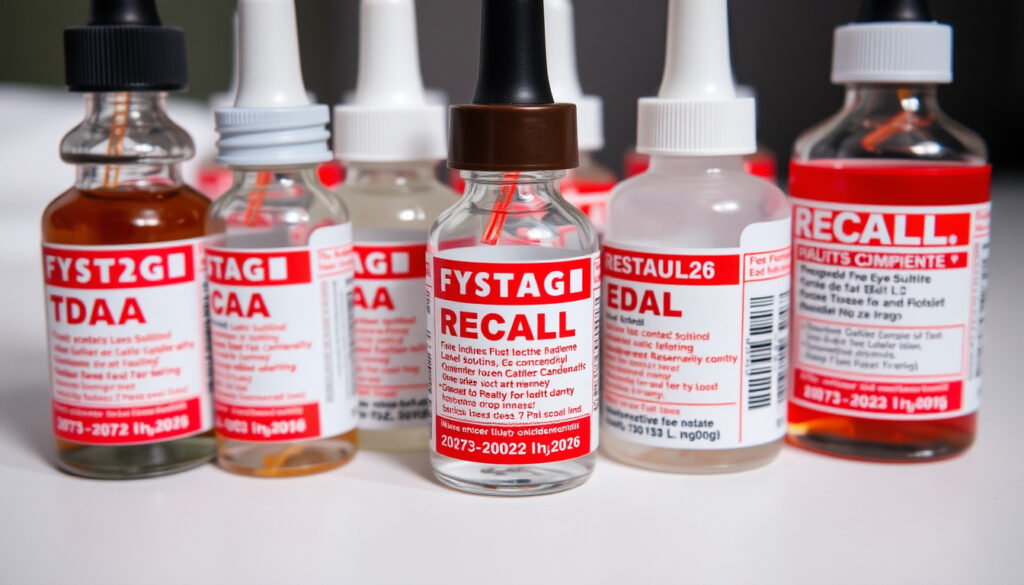
Eye Care Products Recalled: FDA Lists and Brands 2023-2026
A wave of eye drop and eye care product recalls from 2023 through 2026 has pulled over 3 million bottles from store shelves, and not all of them came from the brands you’d expect. The FDA has flagged products from multiple manufacturers after finding sterility problems at production facilities—and some of these drops reached major retailers nationwide.
Bottles Recalled: over 3 million · Brands Affected: 10+ including Leader, AvKARE · Key Recalls: Cardinal Health, Bausch and Lomb · FDA Warnings Issued: multiple since 2023
Quick snapshot
- 2023 recalls tied to Pseudomonas aeruginosa caused 4 deaths, 14 vision loss cases, and 80 infections (UC Davis Health)
- K.C. Pharmaceuticals March 2026 recall covered 3.1 million bottles distributed to Walgreens, Kroger, CVS, and others (CBS News)
- FDA inspectors found insanitary conditions at the Kilitch Healthcare India facility, with positive bacterial tests from critical production areas (FDA)
- Current status of Systane and Refresh-brand products not involved in recalls
- Whether additional 2026 recalls may follow the K.C. Pharmaceuticals action
- Full scope of intraocular lens recall details from Bausch and Lomb
- Nov 2023: FDA warns on several major eye drop brands
- May 2025: AvKARE artificial tears recall
- Apr 2026: FDA flags over 3 million bottles
- 2026: Bausch and Lomb intraocular lens lawsuit
- FDA continues inspecting manufacturing facilities in India
- Consumers should check lot numbers against FDA recall databases
- Private-label manufacturing vulnerabilities may trigger further actions
The table below summarizes the key figures and classifications associated with the ongoing recall wave.
| Label | Value |
|---|---|
| Total Bottles Flagged | over 3 million (2026) |
| Initiator Example | Cardinal Health voluntary |
| Date of Latest | May 2025 AvKARE |
| Risk Highlighted | Eye infections from contamination |
| Largest Single Lot | 1,023,096 bottles (Dry Eye Relief) |
| 2023 Death Toll | 4 fatalities linked to recalled drops |
| Vision Loss Cases | 14 documented cases (2023 outbreak) |
| FDA Classification | Class II (temporary harm possible) |
What brands of eye drops are being recalled?
The recall landscape spans private-label products sold under store brands alongside products from named manufacturers. Cardinal Health’s Leader brand line faced an early recall covering multiple product types. The March 2026 recall by K.C. Pharmaceuticals involved 3.1 million bottles distributed under brand names including Dry Eye Relief Eye Drops, Artificial Tears Sterile Lubricant Eye Drops, Best Choice, CVS, Discount Drug Mart, Gericare, Kroger, and Walgreens (CBS News).
Leader brand products
Cardinal Health initiated a voluntary recall of all lots of six Leader brand eye care products. The recall reflected manufacturing concerns identified through FDA audits, marking one of the first major private-label actions in the ongoing recall wave.
AvKARE artificial tears
In May 2025, AvKARE recalled artificial tears and eye care products due to manufacturing violations identified at the production facility. The recall included products with expiration dates ranging from April 2025 through March 2027 (GoodRx). Products were distributed nationwide.
Systane and Refresh status
Systane and Refresh products not involved in specific recall actions remain available. Systane products were not implicated in any recall through 2026. Refresh products outside specific recall actions also remain available. However, the September 2024 recall of Refresh P.M. and Refresh Lacri-Lube by Allergan involved tube sealing defects where the bottom of the tube may not seal properly (GoodRx). These recalled products had expiration dates ranging from September 2024 through May 2027.
What eye ointments are being recalled?
Eye ointments have faced recalls alongside drops, with manufacturing sterility emerging as the consistent theme. The FDA has identified quality risks at multiple production facilities, triggering actions that pulled products from Walmart, CVS, and other national retailers.
Nighttime ointments for dry eyes
Allergan’s Refresh P.M. and Refresh Lacri-Lube lubricant eye ointments were recalled in September 2024 due to tube sealing issues. The defect could compromise product sterility, posing infection risk to users.
Gels and ointments affected
In February 2024, lubricant eye ointments manufactured by Brassica Pharma Pvt. Ltd. were recalled due to sterility concerns identified during FDA inspection. The products had been sold nationwide at retailers including Walmart and CVS with expiration dates ranging from February 2024 to September 2025 (GoodRx).
Ointment recalls often receive less attention than drop recalls, but the infection risk is identical. Patients using nighttime eye products should verify lot numbers just as carefully as they would for drops.
What cataract lenses are being recalled?
Beyond topical eye products, the intraocular lens category has faced regulatory scrutiny in 2026. Bausch and Lomb products have been connected to ongoing litigation and recall actions, though specific details of the scope remain partially unclear.
Bausch and Lomb intraocular lenses
Bausch and Lomb intraocular lenses have been subject to a 2026 lawsuit and recall action. The company, a major player in ophthalmic devices, faces claims related to product performance. The pattern mirrors the pharmaceutical recall wave in identifying manufacturing facility concerns as the root cause.
Patients who received intraocular lenses should contact their surgeons directly to verify whether their implants are affected by any current recall actions.
What is the latest on eye drop recalls?
The March 2026 K.C. Pharmaceuticals recall represents the largest single action in the ongoing recall wave. The FDA classified it as Class II, describing products that may cause temporary or medically reversible adverse health consequences (CBS News). One K.C. Pharmaceuticals lot alone involved 1,023,096 bottles sold under the Dry Eye Relief Eye Drops brand at stores including Rite Aid, H-E-B, and Harris Teeter.
FDA audit findings
FDA investigators found insanitary conditions at the Kilitch Healthcare manufacturing facility in India, with positive bacterial test results from environmental sampling of critical drug production areas (FDA). The tainted Pseudomonas aeruginosa products from the 2023 outbreak were also manufactured at facilities in India (Nashua Eye Associates).
2025 and 2026 updates
Non-sterile manufacturing conditions have been cited as the reason for numerous eye drop product recalls since 2023 (Nashua Eye Associates). The 2026 recall followed a similar pattern: FDA sterility concerns triggered the K.C. Pharmaceuticals action, which distributed products to Walgreens, Kroger, CVS, H-E-B, Meijer, and other retailers (UC Davis Health).
How to check if your eye care products are recalled?
Consumers should take immediate action to verify whether their eye care products are affected by any active recall. The FDA maintains a publicly accessible recall database that allows searches by product name, manufacturer, or lot number.
Eye drop recall check
To verify your products: locate the lot number on the bottle or tube (typically near the expiration date), then cross-reference it against the FDA’s recall announcements. For the March 2026 K.C. Pharmaceuticals recall, any Dry Eye Relief Eye Drops, Artificial Tears Sterile Lubricant Eye Drops, or store-brand products from the affected lots should be discontinued immediately.
- Check the lot number on the product container
- Visit FDA.gov and search the current recall list
- Compare product names against recall announcements
- Return affected products to place of purchase for refund
FDA recall list
The FDA website provides updated recall information organized by product category. For eye care specifically, the relevant section includes ophthalmic drugs and medical devices. Consumers should check periodically, as new recalls can be issued at any time.
If you bought store-brand eye drops between 2023 and 2026, there’s a meaningful chance they fall under a recall. The FDA’s database is searchable in minutes—worth doing before your next use.
Timeline of eye care product recalls
Understanding the sequence of recalls reveals a pattern of manufacturing facility inspections triggering successive waves of action. What began as an outbreak response in 2023 has evolved into an ongoing regulatory campaign targeting overseas production standards.
| Date | Event |
|---|---|
| February 2023 | FDA announces recall of EzriCare and Delsam Pharma artificial tears after Pseudomonas aeruginosa outbreak linked to 4 deaths, 14 vision loss cases, and 80 infections (UC Davis Health) |
| March 3, 2023 | Pharmedica USA recalls Purely Soothing 15% MSM Drops over sterility concerns |
| March 2023 | Apotex recalls Brimonidine Tartrate Ophthalmic Solution due to cracked bottle caps |
| October 2023 | Kilitch Healthcare India Limited recall; products sold at CVS, Target, Walmart |
| February 2024 | Brassica Pharma Pvt. Ltd. recalls lubricant eye ointments |
| September 2024 | Allergan recalls Refresh P.M. and Refresh Lacri-Lube due to tube sealing defects |
| March 2026 | AvKARE recalls artificial tears due to manufacturing violations |
| March 2026 | K.C. Pharmaceuticals recalls 3.1 million bottles; largest recall in the series |
What we know and what we don’t
The recall pattern shows clear confirmed facts alongside areas where information remains incomplete.
Confirmed
- Cardinal Health Leader recall covered all lots of six products (GoodRx)
- AvKARE products were recalled with nationwide distribution (GoodRx)
- FDA audit violations cited insanitary conditions at manufacturing facilities (FDA)
- 2023 outbreak caused 4 deaths, 14 vision losses, 80 infections (UC Davis Health)
- K.C. Pharmaceuticals recall involved 3.1 million bottles (CBS News)
Unclear
- Systane 2026 recall details not confirmed
- Refresh current status (products not involved in recalls)
- Full ointment list beyond known recalls
- Whether additional manufacturers face upcoming actions
What experts are saying
Eye doctors explain what you should know about the FDA flagging over 3 million bottles of eye drops in 2026.
— UC Davis Health (health institution)
The massive recall reflects ongoing manufacturing and FDA inspection issues affecting over-the-counter eye care products.
— The Conversation (health news analysis)
FDA investigators found insanitary conditions in the Kilitch Healthcare manufacturing facility and positive bacterial test results from environmental sampling of critical drug production areas.
— FDA (regulatory authority)
Related reading: Benefits of Pumpkin Seeds · Stage 1 Prostate Cancer Symptoms
This action mirrors the extensive full FDA list and steps for over 3.1 million bottles from brands like those recently flagged by regulators.
Frequently asked questions
What caused the eye care product recalls?
Most recalls stem from non-sterile manufacturing conditions identified during FDA inspections of production facilities, particularly in India. Issues include unsanitary conditions, positive bacterial tests from production areas, and physical defects like cracked bottle caps or improperly sealed tubes.
Are all eye drops safe to use?
Eye drops not listed in FDA recall announcements remain available. Major brands like Systane and Refresh products outside of specific recall actions are considered safe for use. Always verify lot numbers if you have any concerns about a specific product.
How does FDA handle eye drop recalls?
The FDA classifies recalls by risk level. Class II recalls, like the March 2026 K.C. Pharmaceuticals action, indicate products that may cause temporary or medically reversible adverse health consequences. The FDA publishes recall announcements and maintains a searchable database for consumers.
What symptoms to watch after using recalled drops?
Symptoms of potential eye infection include redness, pain, vision changes, sensitivity to light, discharge, or feeling of something in the eye. If you experience any of these symptoms after using recalled products, discontinue use immediately and consult an eye care professional.
What alternatives to recalled eye drops?
Alternatives include products from manufacturers not involved in recalls, such as Systane or Refresh items outside of specific recall actions. Artificial tears from major pharmaceutical manufacturers with established quality control processes offer additional options. Consult your eye doctor for personalized recommendations.
More related posts
 Malcolm Webster: Verified Facts and Unanswered Questions
 Brazilian Serie A Games: Schedule, Results & Standings 2026
 Arsenal vs Man United: Man Utd 3-2 Comeback Win
 La Gazzetta dello Sport: History & English Access
 Bart Simpson Real Name, Catchphrases & Autism Questions
 Hyundai Garage Near Me – Find Authorized Service Centers
 Kirby and the Forgotten Land – Guide, Reviews, Switch 2 Edition
 P Louise Advent Calendar – 2024 Contents Reviews Availability
