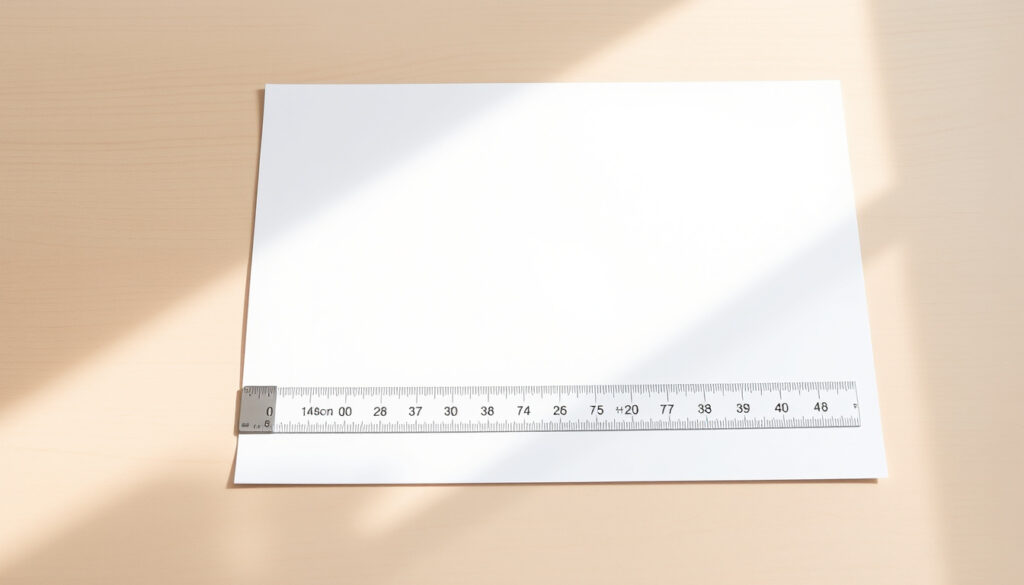
A5 Size in CM – Exact 14.8 x 21 cm Dimensions
A5 paper measures exactly 14.8 cm × 21.0 cm, a dimension established by the ISO 216 international standard adopted in 1975. This compact format sits between A4 and A6 in the standardized A-series, making it a popular choice for notebooks, small booklets, and professional documents worldwide.
The A5 size serves countless applications across education, business, and creative industries. Understanding its precise measurements helps designers, printers, and everyday users select the right paper format for their needs. The standardized proportions also ensure compatibility with envelopes, folders, and binding equipment globally.
What is the A5 Size in CM?
The A5 paper size in centimeters is 14.8 cm wide by 21.0 cm tall. This exact measurement comes from the ISO 216 standard, which defines the international A-series paper sizes used in most countries outside North America. The dimensions translate to 148 mm × 210 mm in millimeters, providing precision for professional printing and design work.
Key Facts About A5 Dimensions
- Standardized globally by ISO 216 since 1975
- Exactly half the area of A4 when folded along its longer side
- Ideal format for notebooks, planners, and small booklets
- Fits standard C5 envelopes without folding
- Matches the aspect ratio of all A-series sizes for proportional scaling
- Manufactured with tolerances of ±1.5 mm for dimensions under 150 mm
| Unit | Width | Height | Notes |
|---|---|---|---|
| cm | 14.8 | 21.0 | ISO standard |
| mm | 148 | 210 | Exact measurement |
| inches | 5.83 | 8.27 | Approximate |
| points | 420 | 595 | Print industry |
A5 Dimensions in MM and Other Units
Converting A5 dimensions to millimeters yields 148 mm width by 210 mm height. These precise measurements ensure accurate cutting and printing across all professional equipment. The ISO 216 standard permits manufacturing tolerances of ±1.5 mm for dimensions at or below 150 mm, and ±2 mm for sizes between 150 mm and 600 mm.
In inches, A5 measures approximately 5.83 × 8.27, often rounded to 5-7/8 × 8-1/4 inches for practical use. This places A5 close to the North American half-letter size, though A5 is slightly narrower and shorter than half-letter at 140 × 216 mm. The total surface area of an A5 sheet equals 0.031 m², or exactly 1/32 of a square meter.
For digital design work, A5 at 300 DPI print resolution requires 1748 × 2480 pixels. Desktop publishing software typically displays the size in points: 420 pt wide by 595 pt tall.
Understanding the 1:√2 Aspect Ratio
The A-series paper sizes share the aspect ratio of 1:√2, approximately 1:1.414. This mathematical relationship ensures that folding any A-series sheet along its longer side produces two sheets of the next smaller size with identical proportions. When an A4 sheet folds in half, it creates two A5 sheets—a feature designers rely on for consistent layouts across different sizes.
A5 vs Other Paper Sizes
Comparing A5 to other A-series sizes reveals a systematic halving pattern. A4 measures 210 × 297 mm, exactly double A5 when folded along its longer edge. The relationship flows downward through A6 (105 × 148 mm, two A6 sheets from one A5), A7, and beyond. Each step halves the area while preserving proportions.
| Size | mm | cm | inches | Relation to A5 |
|---|---|---|---|---|
| A4 | 210 × 297 | 21.0 × 29.7 | 8.27 × 11.69 | A5 is half A4 |
| A5 | 148 × 210 | 14.8 × 21.0 | 5.83 × 8.27 | Base size |
| A6 | 105 × 148 | 10.5 × 14.8 | 4.13 × 5.83 | Half of A5 |
| Half Letter | 140 × 216 | 14.0 × 21.6 | 5.5 × 8.5 | Similar but different |
The North American letter size (216 × 279 mm) differs significantly from A4 despite appearing similar at first glance. Letter exceeds A4 in width but falls shorter in height. The international standard paper sizes system creates a truly global format that eliminates confusion in international printing and design projects.
Regional Size Differences
Most countries worldwide adopted ISO 216 paper sizes, but North America and parts of Latin America maintain separate standards. US Letter, Legal, and Tabloid sizes use imperial measurements incompatible with the metric-based A-series. Travelers and businesses operating internationally must account for these differences when printing documents or designing materials for global audiences.
A5 fits flat into C5 envelopes, which also accommodate a folded A4 sheet. This compatibility makes A5 ideal for business correspondence and direct mail campaigns where postal regulations specify envelope requirements.
ISO Standard and Common Uses for A5
The ISO 216 standard originated from German DIN 476 in 1922 and gained international acceptance through French precedents before formal adoption in 1975. This standard defines A-series sizes globally, excluding North America and certain regions of Latin America. The harmonized system benefits international trade, academic publishing, and document exchange across borders.
Practical Applications for A5 Paper
A5’s compact dimensions make it the preferred choice for numerous everyday and professional applications. The format balances portability with readability, fitting comfortably in bags while providing sufficient writing or display space. Common uses include:
- Personal notebooks and planners
- Small booklets and brochures
- Flyers and promotional materials
- Menus in hospitality settings
- Government and educational forms
- Travel journals and sketchbooks
- Invitation cards and announcements
The A5 format’s widespread availability makes it cost-effective for short-run printing projects. Standard office supplies, binders, and laminating pouches commonly accommodate A5, reducing production complexity compared to non-standard sizes.
A5 Paper Size Timeline
The standardization of A-series paper sizes developed over several decades before achieving global acceptance. Understanding this history explains why A5 and other A-series formats behave as they do today.
- 1920s — German engineers propose the A-series concept based on the 1:√2 aspect ratio for efficient paper production
- 1922 — DIN 476 establishes the official German standard for A-series sizes
- Early 20th century — France develops similar proposals independently, influencing international adoption
- 1975 — ISO 216 formally adopts the A-series as an international standard for paper sizes
- Present — A5 and A-series sizes serve as default formats in most countries, excluding North America
Understanding A5 Dimensions: What Is Clear and What Remains Unclear
| Established Information | Less Defined Areas |
|---|---|
| A5 dimensions: 148 × 210 mm (14.8 × 21.0 cm) | Regional variations in manufacturing slight |
| ISO 216 defines exact specifications | Micro-tolerances in mass production |
| Aspect ratio: 1:√2 | Historical document dating |
| Half A4 when folded | Specific industry preferences vary |
The core dimensions of A5 paper are fixed and universally accepted through ISO 216. Manufacturing tolerances allow minor variations, but these remain within tight parameters (±1.5 mm for smaller dimensions). What varies more significantly is how different industries and regions interpret usage recommendations, though the physical dimensions remain consistent.
Why the A5 Size Matters in Modern Applications
The A5 format occupies a practical niche between large A4 documents and tiny A6 cards. This middle ground serves as a versatile standard that meets diverse needs without requiring custom cutting. Digital transformation has further solidified A5’s relevance as screen sizes and portable devices increasingly favor compact, readable formats.
Professionals in fields requiring international collaboration benefit from standardized sizes that eliminate translation errors between metric and imperial systems. The A5 size, along with the rest of the ISO 216 series, provides a common language for paper dimensions worldwide.
Sources and Standards Reference
“The A series is based on the aspect ratio 1:√2, which means that the ratio between the longer and shorter side of each size equals the square root of 2, ensuring that folding the paper in half along its longer side produces two sheets of the next smaller size with the same proportions.”
— ISO 216 International Standard
Technical specifications for A5 derive from multiple authoritative sources including Dimensions.com, Paper Sizes Wiki, and official standards documentation. The consistency across sources confirms the reliability of published measurements. The Paper Sizes reference database and industry publications corroborate these findings.
Summary
A5 paper measures exactly 14.8 cm × 21.0 cm, making it precisely half the size of A4 when folded along its longer side. This international standard format, defined by ISO 216, serves everything from personal notebooks to professional brochures. The consistent 1:√2 aspect ratio ensures proportional scaling across all A-series sizes, simplifying design work and international document exchange. For those comparing paper formats, understanding A5’s exact centimeters provides the foundation for selecting appropriate materials in any project.
Frequently Asked Questions
Is A5 14.8 x 21 cm?
Yes, A5 measures exactly 14.8 cm wide by 21.0 cm tall, as defined by ISO 216. These precise centimeter dimensions correspond to 148 mm × 210 mm in millimeters.
What is A5 size in inches?
A5 measures approximately 5.83 × 8.27 inches, often rounded to 5-7/8 × 8-1/4 inches for practical applications. This makes it similar to but slightly smaller than the North American half-letter size.
How does A5 compare to A4?
A5 is exactly half the area of A4. Folding an A4 sheet along its longer side produces two A5 sheets with identical proportions. A4 measures 210 × 297 mm while A5 measures 148 × 210 mm.
What is A5 paper commonly used for?
A5 suits notebooks, planners, small booklets, flyers, menus, and invitations. Its compact size balances portability with readability, fitting easily in bags while providing adequate writing space.
Does A5 fit standard envelopes?
A5 fits flat inside C5 envelopes, which also accommodate a folded A4 sheet. This makes A5 practical for business correspondence and mailing applications worldwide.
What is the aspect ratio of A5 paper?
A5 uses the 1:√2 aspect ratio, approximately 1:1.414. This mathematical proportion ensures that folding any A-series paper produces sheets with consistent dimensions, simplifying scaling and design work.
How accurate are A5 dimensions?
A5 dimensions are fixed at 148 × 210 mm by ISO 216. Manufacturing tolerances permit ±1.5 mm for dimensions under 150 mm, ensuring practical production remains within specification.
What countries use A5 paper?
Most countries worldwide use A5 as part of the ISO 216 standard. North American countries (United States, Canada, and Mexico) primarily use their own sizes (Letter, Legal) rather than A-series formats.
More related posts
 Rebecca Loos: Affair Allegations and 2025 Update
 Aishwarya Rai: Age, Weight, Family, and Updates
 เว็บ pgroyal88.com 🔥: Latest Verified Info & Key Facts
 Eid al-Adha 2026: Dates, Predictions, and Celebration Guide
 Tamil to English Translation: Best Methods and Tools
 Cast of Carrie 1976: Full List, Roles & Actor Trivia
 Alexia Putellas: Relationship, Salary, & Why She’s Leaving
 Bank Holidays in 2024: Dates for Ireland, UK, US & Pakistan
