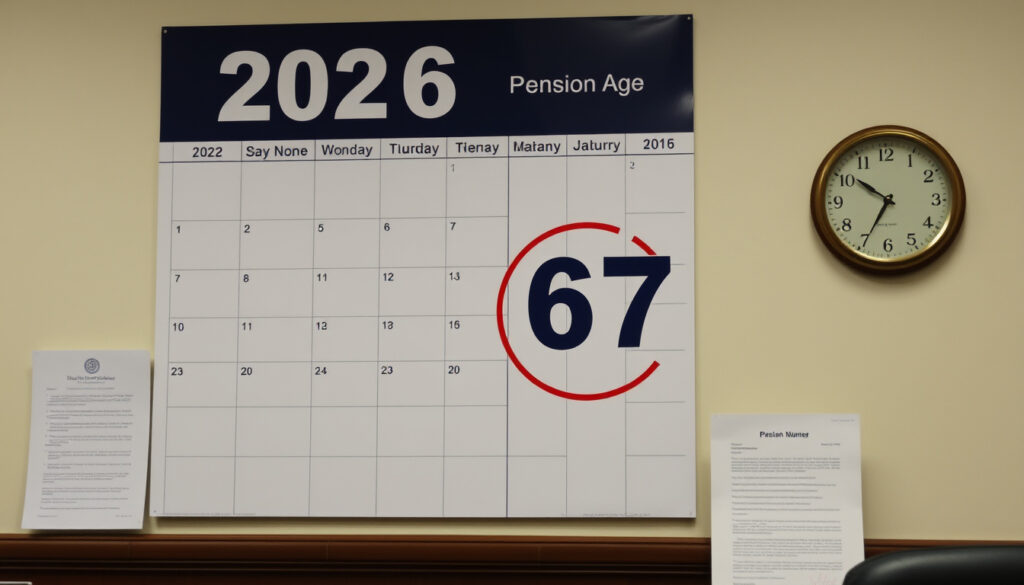
UK Retirement Age Changes 2026: State Pension Age Rising to 67
Few things get people checking the calendar quite like the State Pension age. The UK’s retirement age is rising again: from 66 to 67 between 2026 and 2028, with a further increase to 68 already on the books for those born after April 1977, and this article lays out the timeline, what it means for different birth cohorts, and how the UK compares with other wealthy nations.
Current SPA: 66 · SPA increase to 67 begins: April 2026 · SPA reaches 67: by March 2028 · Next increase to 68: for those born after April 1977 · Full new State Pension (2025/26): £221.20/week
Quick snapshot
- SPA will rise to 67 by March 2028 (Peninsula Pensions (pension policy analysts))
- Default retirement age of 65 has been abolished (GOV.UK (official UK pension timetable))
- State pension increases annually by the triple lock (GOV.UK)
- Exact date of SPA increase to 68 – subject to further review
- Whether future life expectancy changes will push SPA higher
- Impact of economic conditions on triple‑lock calculations for 2026/27
- April 2026: SPA starts rising from 66 to 67 (GOV.UK (government timetable PDF))
- March 2028: SPA reaches 67 for all affected (GOV.UK (government timetable PDF))
- 2044‑2046: SPA rise to 68 scheduled (GOV.UK (government timetable PDF))
- 2023 review endorsed the 67 timetable but did not accelerate 68 (Wikipedia (summary of pension legislation))
- Next full SPA review expected within five years (Peninsula Pensions)
Six key figures, one pattern: the State Pension age has climbed steadily over two decades and is now firmly set above 66 for nearly everyone.
| Metric | Value |
|---|---|
| Current State Pension age | 66 |
| Next increase starts | April 2026 |
| Full increase to 67 complete by | March 2028 |
| Planned increase to 68 for | those born after April 1977 |
| Full new State Pension (2025/26) | £221.20 per week |
| Basic State Pension (2025/26) | £169.50 per week |
Is the UK State Pension age going to change?
What is the current state pension age?
As of October 2020, the State Pension age (SPA) is 66 for both men and women (Wikipedia (pension legislation history)). People born between 6 October 1954 and 5 April 1960 reached SPA at 66 (The People’s Pension (UK workplace pension provider)).
When will the state pension age rise to 67?
The increase from 66 to 67 begins in April 2026 and continues in monthly steps until April 2028 (The Independent (UK news outlet)). Anyone born on or after 6 April 1960 will see their SPA gradually increase – for example, those born between 6 April 1960 and 5 May 1960 reach SPA at 66 years and 1 month (GOV.UK (government pension timetable PDF)). The full rise to 67 applies to everyone born before 5 April 1977 (The Independent).
When will the state pension age rise to 68?
The Pensions Act 2007 set the next leg – 67 to 68 – between April 2044 and April 2046 (GOV.UK (government pension timetable PDF)). That timetable applies to people born on or after 5 April 1977 (The People’s Pension). A review in 2023 endorsed the 67 schedule but did not bring the 68 rise forward (Wikipedia (pension legislation history)).
For the cohort born between April 1961 and March 1977, the shift to 67 is locked in. Those born after April 1977 face an even later state pension – possibly beyond 68 if life expectancy continues to climb.
The implication: three distinct birth cohorts now face three different retirement ages. Knowing your exact birth date and the corresponding SPA is no longer optional – it’s essential for financial planning.
Why is the state pension age going up again?
What factors drive pension age increases?
Rising life expectancy and the resulting fiscal pressure on the state pension system are the primary drivers. The Pensions Act 2014 accelerated the 66-to-67 rise by eight years precisely because people are living longer (GOV.UK (official pension timetable)). The Institute for Fiscal Studies has noted that “rising life expectancy and fiscal pressures drive the change” (Peninsula Pensions (pension policy research)).
How does life expectancy affect state pension?
The government reviews SPA at least every five years, using life expectancy projections to decide whether further increases are needed (Peninsula Pensions). A longer average lifespan means the pension pot must stretch across more years, making later retirement ages financially necessary.
Pushing the pension age later reduces the number of years the average person draws the state pension, lowering the long-term cost to the Treasury. For workers, that means more years of contributions before they see a penny.
The trade-off: a sustainable pension system for the country, but a later start to retirement income for individuals. The burden falls most heavily on those in physically demanding jobs who may struggle to work longer.
Can you still work if you retire at 65?
What is the default retirement age?
The default retirement age of 65 – the age at which employers could force workers to retire – was abolished in 2011 (GOV.UK (government guidance)). There is no longer a mandatory retirement age in the UK.
Do I need to stop working at state pension age?
No. You can continue working past your SPA without any penalty. You can also defer taking the state pension, which increases the weekly amount you receive later (GOV.UK (deferring state pension guidance)).
- You may keep working and delay claiming your pension.
- Deferring can boost your weekly income by roughly 1% for every nine weeks you delay.
The catch: while you can keep working, your SPA still determines when you become eligible for the state pension. If you stop work before that age, you’ll have a gap with no state income unless you have private savings or a workplace pension.
Is the UK state pension the least generous in the G7?
How does UK state pension compare to other G7 countries?
According to OECD data compiled by the Institute for Fiscal Studies, the UK’s state pension replaces a lower share of pre‑retirement earnings than any other G7 nation (Peninsula Pensions (citing IFS analysis)). The UK’s replacement rate – the percentage of average earnings paid by the state pension – sits at around 20%, compared with roughly 40% in France and 50% in Italy.
What is the average state pension amount in the UK?
The full new State Pension is £221.20 per week (2025/26), and the basic State Pension is £169.50 per week (GOV.UK (new state pension rates)). That equates to roughly £11,500 a year – below the UK’s official living wage for a single person.
The pattern: a low state pension places more responsibility on individuals to save privately. The UK is an outlier in the G7 for its reliance on workplace and personal pensions to top up a relatively modest state provision.
Is there an increase for pensioners in 2026?
When is the next state pension increase?
State pensions rise every April under the triple lock – the highest of average earnings growth, CPI inflation, or 2.5%. The April 2026 increase will be announced later in 2025 based on economic data (GOV.UK (triple lock explanation)).
How much will the state pension increase in 2026?
The exact 2026 figure is not yet known. Based on current earnings growth trends, some analysts expect an increase of around 4‑5% (The Independent (pension analysis)). The triple lock ensures that whatever the inflation or earnings figure, the pension will at least keep pace.
The triple lock is a major driver of government spending. If earnings surge, the April 2026 increase could be unusually high – but that also makes the policy a political target for reform.
The stake: for current pensioners, the triple lock provides certainty. For future cohorts, the combination of a later SPA and a relatively low replacement rate means they will work longer for a pension that still requires substantial top‑ups from private savings.
Timeline of UK State Pension age changes
- 2010‑2020 – SPA gradually increased from 65 to 66 for both sexes (GOV.UK (pension timetable))
- April 2026 – SPA starts rising from 66 to 67 (The Independent)
- March 2028 – SPA reaches 67 for all affected cohorts (Peninsula Pensions)
- Under review – Further increase to 68, likely for those born after April 1977, scheduled 2044‑2046 (GOV.UK)
Confirmed facts
- SPA will rise to 67 by March 2028 (Peninsula Pensions)
- Default retirement age of 65 has been abolished (GOV.UK)
- State pension increases by triple lock every April (GOV.UK)
Uncertainties
- Exact date of SPA increase to 68 (subject to review)
- Whether future life expectancy changes will push SPA higher
- Impact of economic conditions on triple lock calculations for 2026/27
“Rising life expectancy and fiscal pressures drive the change.”
– Institute for Fiscal Studies, as reported by Peninsula Pensions (pension policy research)
“People need clear information about their state pension age well in advance.”
– Age UK spokesperson, via The Independent (UK news)
“The state pension age is rising to 67 to reflect longer life expectancy.”
– Government press release, as cited in The Independent
For anyone born after April 1960, the choice is clear: plan for a later retirement, or find ways to bridge the gap between the age you stop working and the day the pension starts. With the UK state pension already among the least generous in the G7, relying solely on the state is not a viable strategy. The onus is on individuals to save more, work longer, or both.
Frequently asked questions
What is the state pension age for women born in 1962?
Women born in 1962 have a state pension age of 67 (since they are born after 6 April 1960). The exact age depends on the month of birth – for example, someone born in March 1962 reaches SPA at 67 years and 10 months.
Will the state pension age go to 68 sooner than planned?
The 2023 review did not bring the 68 rise forward. It remains scheduled for 2044‑2046 for those born after April 1977. Further reviews may change this.
Can I retire at 66 and still claim state pension?
You can retire at any age, but you can only claim the state pension when you reach your SPA. If you retire at 66 but your SPA is 67, you will have no state income until you reach 67.
Does the state pension increase if I delay claiming?
Yes. Deferring the state pension increases the weekly amount you receive. For every 9 weeks you delay, the pension increases by about 1% (around 5.8% per year).
How do I check my state pension age?
Use the government’s online checker at GOV.UK (official SPA calculator). Enter your date of birth to get your exact age.
What happens if I continue working past state pension age?
You can keep working without penalty. You do not have to claim the state pension immediately. If you defer, you will get a higher weekly amount later.
Is the triple lock guaranteed for the future?
The triple lock is government policy but not enshrined in law permanently. It has been recommitted in recent budgets, but future governments could change it.
More related posts
 Levi Roots: Net Worth, Family, and Reggae Reggae Sauce
 Phillipa Coan: Biography, Age, Children, and Marriage
 Engli h to Wel h Tran lation: Phra e , Tool , and Cultural Guide
 Car Insurance Group Checker: Free Tools & UK Guide
 Legal & General Dividend Dates: 11.69% Yield & History
 Inpost Locker Near Me – UK Map, Locations and Usage Guide
 MCU Movies in Order: Release & Chronological Watch Guide
 What Time Is It in the UK – Live Clock and GMT/BST Guide
