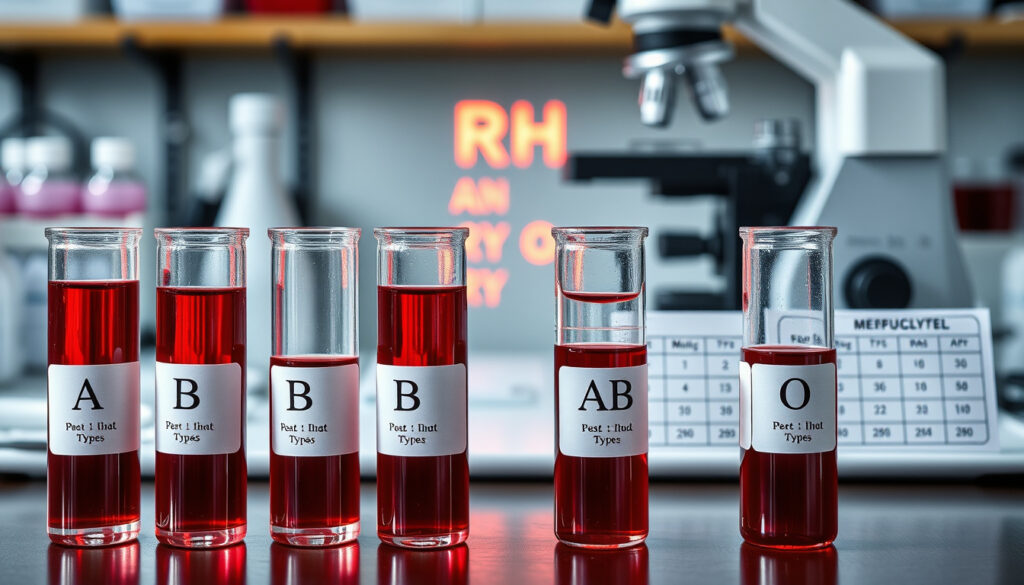
Blood Types: Rarity, Compatibility, and Key Facts
Few things say more about human diversity than the blood running through our veins. The ABO system and Rh factor combine to create 8 common blood types, with O positive leading the global frequency charts.
Blood group systems: ABO and Rh ·
Total common blood types: 8 ·
Most common blood type globally: O positive ·
Rarest common blood type: AB negative ·
Universal red cell donor: O negative
Quick snapshot
- Four groups: A, B, AB, O — based on A and B antigens (American Red Cross (humanitarian blood service))
- Positive or negative; Rh-negative is less common (American Red Cross)
- Rhnull: rarest; AB negative: rarest common; O positive: most common (NHS Blood Donation (UK national blood service))
- O- universal donor; AB+ universal recipient; cross-match required (Our Blood Institute (US blood centre))
Of the 8 common blood types, a few clear patterns emerge in terms of rarity, demand, and compatibility.
| Label | Value |
|---|---|
| ABO groups | 4 (A, B, AB, O) |
| Rh types | 2 (+ and -) |
| Total common types | 8 |
| Most common in Ireland | O positive (~47%) |
| Rarest common | AB negative (~1%) |
| Universal donor | O negative |
What is a rarest blood type?
The rarest blood type overall is Rhnull, a condition so unusual that fewer than 50 individuals are known to carry it (Abbott Newsroom (diagnostics company)). Among the 8 common ABO/Rh types, AB negative is the rarest, making up about 1% of donors in the UK according to the NHS Blood Donation (UK national blood service).
What are the 3 rarest blood types?
- AB negative — approximately 1% of donors
- B negative — approximately 3% of donors
- AB positive — approximately 2% of donors
These figures come from the NHS Blood Donation donor breakdown (February 2026), which also shows O positive (36%) and A positive (28%) as the most common.
Which is rare, A+ or O+?
Neither A+ nor O+ is rare. O positive is the most common blood type globally, and A positive is the second most common. In the UK, about 36% of donors are O positive and 28% are A positive. So the answer is clear: A+ and O+ are both very common.
The implication: rarity scales inversely with demand for certain types, making AB negative a small but critical group to recruit.
Why is O negative better than O positive?
O negative is called the universal red cell donor because its red blood cells lack A, B, and Rh antigens, making them safe for nearly any recipient (NHS Blood Donation). O positive, while the most common type, can only be given to Rh-positive recipients. In emergencies when a patient’s blood type isn’t known, O negative is the only choice.
What are the disadvantages of O negative blood?
Upsides
- Universal donor for red blood cells — always in high demand
- Accounts for about 13% of hospital red cell requests in the UK
Downsides
- Can only receive red blood cells from other O negative donors (Our Blood Institute)
- Only about 8% of the UK population has O negative — supply is tight
The implication: O negative’s life-saving versatility comes with a supply-demand imbalance. Blood banks constantly recruit O negative donors because the need is disproportionate to the population share.
What blood type do most Irish have?
A modern Ireland study published by PMC / NIH (peer-reviewed biomedical database) found that O positive is the most common blood type in Ireland, with an expected prevalence of about 56% for group O and 83% RhD positive. The study’s expected prevalence for Ireland was Group A 31%, Group B 11%, Group O 56%, Group AB 3%, and RhD positive 83%.
An earlier report in Nature (scientific journal) examined 21,894 Irish donors and found 83.87% Rh-positive and 16.13% Rh-negative, with Dublin-born donors at 82.93% and 17.07% respectively. These consistent figures confirm that about 47% of Irish donors are O positive — a pattern that aligns with the global prevalence of type O.
What this means: Ireland’s blood type distribution closely mirrors other European populations, making O negative donors equally critical for the Irish Blood Transfusion Service.
What two blood types don’t mix?
Two blood types that don’t mix are those from different ABO or Rh groups when a recipient has antibodies against the donor’s antigens. The classic example is ABO incompatibility, which can occur when a mother and baby have different blood types — for instance, an O negative mother carrying an A positive baby.
What is ABO incompatibility?
ABO incompatibility happens when a mother’s immune system produces antibodies that attack the baby’s red blood cells, potentially leading to hemolytic disease of the newborn. Treatment includes monitoring, phototherapy, and in severe cases, exchange transfusion. The condition is manageable when detected early, which is why prenatal blood type testing is standard.
Most cases of ABO incompatibility are mild, but they illustrate why blood type matching matters far beyond transfusions — it can affect pregnancy outcomes too.
The pattern: early detection through prenatal screening prevents serious complications for newborns at risk.
What is special about A+ blood?
A positive is the second most common blood type, present in about 28% of UK donors. Its special role: A+ can donate to A+ and AB+ recipients, and can receive from A+, A-, O+, and O-, making it a flexible intermediate type. Because it’s so common, A+ blood is frequently used for transfusions and helps maintain stable hospital supplies.
What was Jesus’s blood type?
No scientific evidence exists to determine Jesus’s blood type. Some analyses of relics such as the Shroud of Turin have produced speculative claims — including one that suggests AB blood type — but these are not scientifically verified and remain unsubstantiated. The question, while intriguing, currently sits outside the realm of empirical science.
The catch: curiosity about historical figures’ blood types often outstrips what forensic science can actually confirm.
Six blood types, one pattern: the trade-off between frequency and versatility. O negative is the universal donor but scarce; AB negative is rare but can receive almost any type.
| Blood Type | Can Donate To | Can Receive From | UK Donor % |
|---|---|---|---|
| O negative | All types | O negative only | 14% |
| O positive | O+, A+, B+, AB+ | O+, O- | 36% |
| A negative | A-, A+, AB-, AB+ | A-, O- | 8% |
| AB negative | AB-, AB+ | All Rh-negative types | 1% |
The trade-off: O negative donors are in constant high demand, yet fewer than 1 in 10 people can supply it. For blood banks, this means proactive recruitment is essential.
Confirmed facts
- O negative is the universal red cell donor (American Red Cross)
- AB negative is the rarest common blood type
- O positive is the most common blood type globally and in Ireland (PMC / NIH)
- ABO incompatibility can cause hemolytic disease in newborns
What’s unclear
- Jesus’s blood type remains unknown; relic analyses are inconclusive
- Exact number of Rhnull individuals is uncertain but estimated under 50 (Abbott Newsroom)
- Global prevalence of rare blood types varies by region; complete census data does not exist
- Whether blood type influences susceptibility to diseases (e.g., COVID-19) is still being studied with mixed results
One in four people will need a blood transfusion at some point in their lives.
— Irish Blood Transfusion Service (national blood service)
77% of our donors are Rh D positive, which underscores the shortage of O negative and other Rh-negative types.
— NHS Blood Donation (UK national blood service)
For blood banks in Ireland, maintaining a steady supply of O negative blood is a constant challenge: less than 10% of the population carries the universal type, yet it’s required for every emergency when the patient’s type is unknown. The choice is clear: recruit more O negative donors, or risk shortages in critical moments.
youtube.com, youtube.com, en.wikipedia.org, my.clevelandclinic.org, youtube.com
Frequently asked questions
Can blood type change?
Blood type is determined genetically and remains the same for life, except in extremely rare cases such as bone marrow transplants or certain cancers that can alter antigen expression.
How often can you donate blood?
In the UK, men can donate every 12 weeks and women every 16 weeks, as per NHS Blood Donation guidelines.
Which blood types are compatible for transfusion?
Compatibility depends on ABO and Rh matching. O negative can donate to all; AB positive can receive from all. Always cross-matched.
What is Rh disease?
Rh disease (hemolytic disease of the newborn) occurs when an Rh-negative mother carries an Rh-positive baby and her immune system attacks the baby’s red blood cells. Preventable with anti-D immunoglobulin.
Why is blood type important in pregnancy?
Maternal blood type screening detects potential ABO or Rh incompatibility early, allowing monitoring or treatment to protect the baby.
What is the most common blood type globally?
O positive is the most common blood type worldwide, found in about 36-40% of populations depending on region.
More related posts
 Wesley Plaisier: Career, Rankings, and Personal Life (2025)
 Millie Bright Retirement: Career, Partner and What’s Next
 Claudia Winkleman No Makeup: Why She Hides Her Eye
 Gary Stevenson: Trader to Activist – Facts vs Myths
 Park Hyung-sik: Age, Dramas, Height, Girlfriend Rumors
 Steven Van Zandt: Bandana, Biography, and Springsteen Link
 Sienna Spiro: Ethnicity, Voice, Neurodivergence & Hit Song
 Mark Lamarr Driving Ban 2026: What Happened to the Comedian
