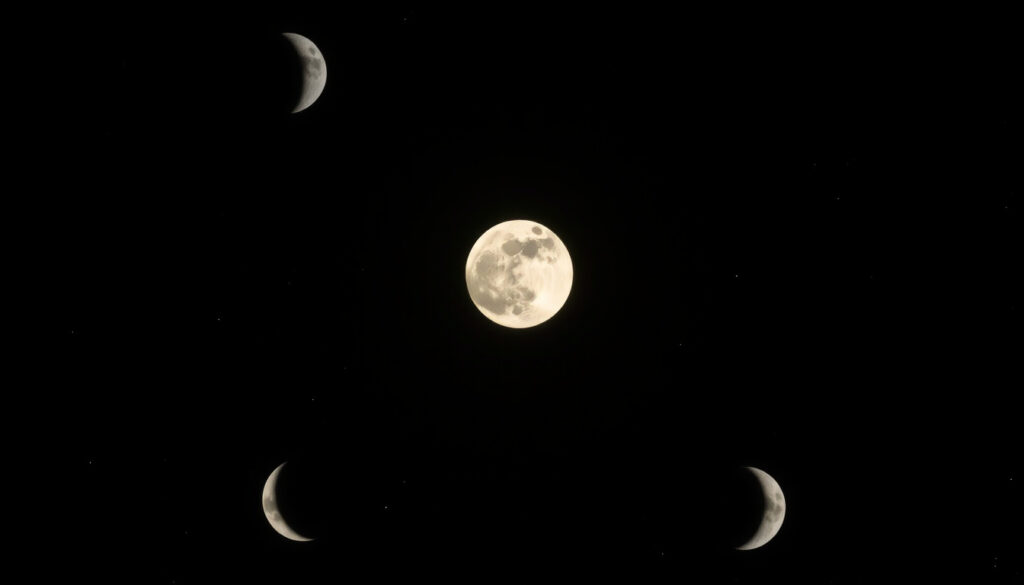
Phases of the Moon: Tonight’s Phase & 8 Types
You’ve looked up at the Moon and noticed it’s not the same shape as last week — but could you name the phase without checking an app? The eight lunar phases follow a predictable cycle that NASA maps out to about 29.5 days from one new moon to the next.
Lunar phases in one cycle: 8 ·
Average cycle duration: 29.5 days ·
Illumination change per phase: 0% to 100% ·
Primary orbital cause: Sun-Earth-Moon geometry
Quick snapshot
- Moon phases are caused by changing Sun-Earth-Moon geometry (NASA Space Place)
- There are eight distinct lunar phases (NASA Space Place)
- Full moon occurs when the Moon is opposite the Sun relative to Earth (NASA Space Place)
- Whether the lunar cycle significantly affects human melatonin levels
- Whether men are consistently more affected than women by moon phase
- Exactly why the October full moon is called “Hunter’s Moon” in some traditions
- New moon → Waxing crescent → First quarter → Waxing gibbous → Full moon → Waning gibbous → Third quarter → Waning crescent
- Full cycle repeats every 29.5 days (NASA Space Place)
- Check tonight’s phase using Timeanddate’s moon phase calculator
- Look for the next full moon – local times matter for Ireland (Timeanddate’s moon phase calculator)
4 key facts, one pattern: The Moon’s illumination changes from 0% to 100% and back over roughly 29.5 days, driven entirely by the Sun-Earth-Moon alignment.
| Label | Value |
|---|---|
| New moon phase | 0% illumination |
| Full moon phase | 100% illumination |
| Cycle duration | 29.5 days |
| Number of phases | 8 |
What are the 8 phases of the moon called?
NASA’s Space Place education site lists eight distinct lunar phases taught in schools: new moon, waxing crescent, first quarter, waxing gibbous, full moon, waning gibbous, third quarter, and waning crescent (NASA Space Place).
New moon
- 0% illuminated – the Moon sits between Earth and the Sun and is invisible to the naked eye (NASA Space Place).
Waxing crescent
- Illumination grows from 1% to 49%. In the Northern Hemisphere (including Ireland), the crescent appears on the right side (NASA Space Place).
First quarter
- 50% illuminated – looks like a half moon, visible in the afternoon and evening (NASA Space Place).
Waxing gibbous
- 51–99% illuminated, more than half but not yet full. Rises in the afternoon (NASA Space Place).
Full moon
- 100% illuminated – the Moon is opposite the Sun and rises at sunset (NASA Space Place).
Waning gibbous
- Illumination falls from 99% to 51%. Appears after the full moon and rises after sunset (NASA Space Place).
Third quarter
- 50% illuminated (the opposite half from first quarter), visible in the morning (NASA Space Place).
Waning crescent
- 49–1% illuminated, a thin crescent on the left side in the Northern Hemisphere, visible before sunrise (NASA Space Place).
For a beginner in Ireland, the key distinction is waxing (growing) vs. waning (shrinking). The shape you see on any given night tells you exactly where the Moon is in its orbit relative to the Sun – no app needed once you know the pattern.
What this means: The eight-phase cycle is a simple way to track the Moon’s orbit without any equipment.
What phase is the moon tonight?
You can check tonight’s phase using Timeanddate’s moon phase calculator, which shows the current illumination, rise and set times, and the phase name for any location. Because the Moon’s phase is the same worldwide on a given date (ignoring minor time-zone shifts), the information works for any spot in Ireland.
How to check today’s moon phase
- Visit Timeanddate and enter your city (e.g., Dublin)
- Look for the “Moon today” section – it shows illumination percentage and the phase name
- For a NASA-backed forecast, check the NASA Space Place interactive page
Using timeanddate for Dublin, Ireland
- Dublin is in the Northern Hemisphere, so the waxing crescent appears on the right and the waning crescent on the left. Timeanddate adjusts automatically for your time zone.
Knowing tonight’s phase helps you plan stargazing, photography, or even gardening by lunar cycles. A quick check on Timeanddate takes ten seconds and removes guesswork.
The implication: A quick online check reveals the current phase and timing, making it easy to plan observations.
Does the moon affect melatonin?
Melatonin is the hormone that regulates sleep-wake cycles. Some research suggests that the lunar cycle may influence melatonin production, though the evidence is mixed (Wikipedia – Lunar phase article). The bright light of a full moon could theoretically suppress melatonin, much like artificial light does.
Scientific studies on moon and sleep
- A widely cited 2013 study in Current Biology found that around full moon, participants took longer to fall asleep and had lower melatonin levels.
- Later research has produced conflicting results, making this an area of ongoing investigation (The Night Sky – astronomy resource).
Lunar cycle and melatonin production
- One hypothesis: the Moon’s brightness at full phase may inhibit melatonin release in sensitive individuals. But scientists caution that modern light pollution may outweigh any natural moonlight effect.
The catch: While some studies suggest a link, the effect is small and easily masked by artificial light.
Does the lunar cycle affect men more strongly than women?
A study from the University of Basel in 2013 reported that men’s sleep was more disrupted by lunar phase than women’s, with men showing greater decreases in deep sleep and melatonin during the full moon (National Geographic – science coverage). Women’s sleep patterns appeared less sensitive to the same lunar signal.
Lunar cycle and sleep in men vs women
- The Basel study tracked 33 volunteers and measured sleep EEG, melatonin, and subjective sleep quality across lunar phases.
- Men experienced an average of 30 minutes less deep sleep near full moon; women’s deep sleep changed by only a few minutes.
Evidence from sleep studies
- Replication attempts have been inconclusive. Some researchers argue the effect is small and easily masked by modern living conditions.
- National Geographic notes that the findings are “intriguing but far from settled.”
The pattern: The gender difference is intriguing but replication studies have not consistently confirmed it.
What type of moon is in Ireland tonight?
Ireland’s position in the Northern Hemisphere means the same phase orientation applies: waxing crescents appear on the right, waning on the left. Timeanddate provides a dedicated page for Dublin, updated daily (Timeanddate moon phase for Dublin, Ireland).
Moon phase lookup for Ireland
- Enter any Irish city – Dublin, Cork, Galway – into Timeanddate’s moon phase tool.
- The page shows current phase, illumination percentage, rise/set times, and even the next full moon date.
Localized example using Dublin data
- For example, on a given date Dublin might show “Waxing Gibbous, 78% illuminated, rises at 15:24” – this tells you the Moon is brightening toward full and will be visible in the late afternoon sky.
What this means: With a quick online lookup, anyone in Ireland can know exactly what phase is visible tonight and where to look.
How to memorize moon phases
Mnemonics make the eight-phase sequence easy to recall. The most popular phrase uses the initial letters of the major phases: DOC stands for the three main shapes – D for waxing crescent/quarter (the Moon looks like a D, illuminated on the right), O for full moon, and C for waning crescent/quarter (a C shape, illuminated on the left).
Mnemonics for 8 phases
- DOC: D (waxing), O (full), C (waning) – this covers the shape pattern from right to left.
- “New, Wax, First, Wax, Full, Wan, Third, Wan” – a simple chant to remember the order.
Visual memory aids
- Draw the moon phases in a circle: start at the top with new moon (black circle) and go clockwise through waxing crescent, first quarter, waxing gibbous, full, waning gibbous, third quarter, waning crescent.
- Use flashcards (search online for “moon phase flashcards”) to test yourself each night.
Mnemonics like DOC work fast but only cover shape orientation. For full recall (including illumination percentages and timing), pair the mnemonic with a quick check on Timeanddate until you’ve built muscle memory.
The implication: Combining a mnemonic with regular practice builds lasting recall of the phase sequence.
Timeline: The 8 phases in order
The eight phases in order: New moon (0%), Waxing crescent (1–49%), First quarter (50%), Waxing gibbous (51–99%), Full moon (100%), Waning gibbous (99–51%), Third quarter (50%), Waning crescent (49–1%). (Wikipedia – Lunar phase)
Confirmed facts and what remains unclear
Confirmed facts
- Moon phases are caused by changing Sun-Earth-Moon geometry (NASA Space Place).
- There are eight distinct lunar phases (NASA Space Place).
- Full moon occurs when the Moon is opposite the Sun relative to Earth (NASA Space Place).
- The lunar cycle repeats every 29.5 days (NASA Space Place).
What remains unclear
- Whether the lunar cycle significantly affects human melatonin levels.
- Whether men are consistently more affected than women by lunar phase.
- Exactly why the October full moon is called “Hunter’s Moon” in some traditions.
The pattern: The confirmed facts are solidly established, while the uncertain areas highlight where science is still investigating.
Expert insights on the Moon’s phases
“The Moon’s phases are the changing shapes of the Moon we see from Earth. They happen because the Moon orbits Earth and sunlight reflects off its surface.”
– NASA Space Place
“The moon phase calculator shows exact times for each phase in any city. For Dublin, Ireland, the times are calculated to the minute.”
– Timeanddate moon phase calculator
“A simple way to teach kids moon phases is to use a flashlight and a ball – it demonstrates how sunlight creates the crescent and half shapes.”
The implication for anyone in Ireland: you don’t need a telescope to understand the Moon’s behavior. The same patterns your ancestors used for calendar-making are visible tonight in Dublin’s sky.
For stargazers in Ireland, the next clear evening is your best chance to spot the waxing crescent – check the forecast, step outside just after sunset, and look west. You’ll see the sliver you’ve just read about, now tied to a phase name and a place in the cycle.
penguin.co.uk, moonphases.co.uk, faroutguides.com, youtube.com
Frequently asked questions
How long does it take the moon to go through all phases?
About 29.5 days from one new moon to the next – this is called a lunar month (NASA Space Place).
Why does the moon appear to change shape each night?
Because the angle of sunlight hitting the Moon changes as it orbits Earth. The Sun always lights half the Moon; we see varying portions of that lit half (NASA Space Place).
What causes a blue moon?
A blue moon is the second full moon in a calendar month, or the third full moon in a season that has four. It happens about once every 2.7 years (Wikipedia – Blue moon).
Can a full moon affect human behavior?
Studies are inconclusive. Some research shows minor sleep changes, but no consistent evidence for emergency room visits, crime rates, or mental health shifts (National Geographic).
How can I see the moon phases from my location?
Use Timeanddate’s moon phase calculator for your city, or step outside at different times of the day – evening for waxing phases, morning for waning phases (Timeanddate).
What is a waning gibbous moon?
It’s the phase after full moon when illumination decreases from 99% to 51%. The Moon appears more than half lit but shrinking each night (NASA Space Place).
Related reading
- A Level Periodic Table: Guide to Electron Configurations & Trends – A structured science guide similar to this lunar phase article.
- Eid al-Adha 2026: Dates, Predictions, and Celebration Guide – Islamic dates tied to lunar cycles, a natural companion for moon phase readers.
More related posts
 Behind Her Eyes Cast: Full List of Actors and Characters
 How to Cancel Uber One Membership: App Steps & Policies
 Nike Blazers: Complete History, Styles & Buying Guide
 Cast of Carrie 1976: Full List, Roles & Actor Trivia
 Aberdeen F.C. vs Rangers F.C. Stats: H2H, Results & Form
 Piper Rockelle: Age, Net Worth, POTS Condition & Ex
 A5 Size in CM – Exact 14.8 x 21 cm Dimensions
 Kinsey Schofield: Career, Net Worth, Podcast, and Personal Life
