Flea Bites: Identification, Treatment, and Home Control
Waking up with itchy red bumps on your ankles can be puzzling, but flea bites have a distinct look and pattern that set them apart. This guide helps you identify them, treat the itching, and clear them from your home.
Common bite location: Lower legs and ankles ·
Bite pattern: Clusters or lines ·
Flea species worldwide: over 2,500
Quick snapshot
- Flea bites appear as small, red, raised bumps in clusters or lines (Healthline (health information publisher))
- Bites are most common on lower legs, ankles, and feet (GoodRx (consumer health resource))
- No single product guarantees 100% instant flea kill; integrated methods work best (Healthline (home guidance))
- Exact eradication timeline varies by infestation severity (Healthline (home guidance))
- Vacuuming daily removes flea eggs and larvae (Healthline (home guidance))
- Bites appear within 0-24 hours; itching peaks at 1-2 days
- Complete home eradication takes 1-2 weeks of daily vacuuming and washing
- Treat bites with soap, cold compresses, and anti-itch cream
- Eliminate fleas with EPA-approved products and regular cleaning
Here are the key facts about flea bites at a glance.
| Attribute | Detail |
|---|---|
| Common bite location | Lower legs and ankles |
| Typical bite appearance | Small red bump with red halo |
| Average itch duration | 1-2 days |
| Flea lifespan (adult) | 2-3 months on a host |
| Eggs per day | Up to 50 |
How can I tell if my bites are from fleas?
Where on the body do flea bites usually appear?
Flea bites almost always target the lower extremities. According to GoodRx (consumer health resource), bites are concentrated on the ankles, lower legs, and around the feet. This is because fleas jump from the ground or from pets that spend time on the floor. If you have bites above the waist, fleas are less likely the culprit.
What do flea bite bumps look like?
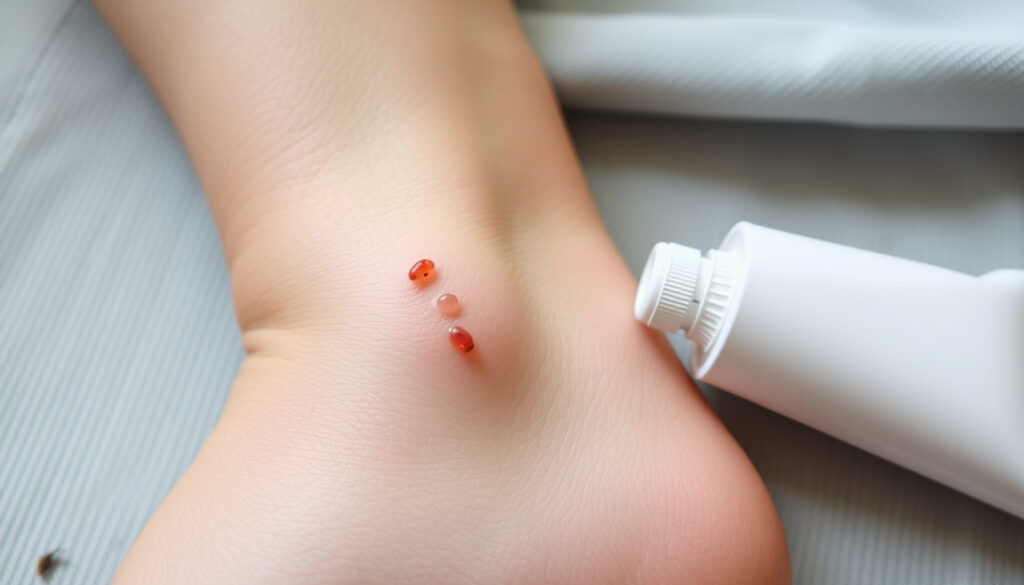
Flea bites are small, raised red bumps—often with a red halo around the center. The Asthma and Allergy Foundation of America (allergy & immunology authority) notes that flea bites produce pain, redness, itching, and minor swelling. Healthline (health information publisher) adds that they often appear in clusters of three or four, or in a short line—sometimes called a “breakfast, lunch, and dinner” pattern. The bites are intensely itchy, and scratching can lead to secondary infection.
Location is your first clue: if the bites hug your ankles and lower legs and form tight clusters, fleas are the likely cause.
The pattern: flea bites almost exclusively target the lower legs, making location the strongest clue.
What can be mistaken for flea bites?
Flea bites are often confused with bed bug and mosquito bites. Knowing the difference can save you from using the wrong treatment.
| Feature | Flea bites | Bed bug bites | Mosquito bites |
|---|---|---|---|
| Location | Lower legs, ankles, feet | Neck, arms, back, upper body | Any exposed skin |
| Pattern | Clusters or short lines | Zigzag or linear rows | Random, singular |
| Size | Small (1-2 mm red dot) | Slightly larger, welt-like | Larger, raised, often with swelling |
| Itch intensity | Intense | Moderate to intense | Moderate |
| Treatment | Cold compress, hydrocortisone, antihistamines | Wash, corticosteroid cream, antihistamines | Cold compress, anti-itch cream |
Flea bites vs bed bug bites
The CDC (U.S. public health agency) warns that bed bug bites can look similar to flea bites. The key difference is location: bed bugs bite exposed skin while you sleep—neck, arms, back—while fleas go for the ankles. Bed bug bites also tend to form a zigzag or line pattern, whereas flea bites are more scattered (Healthline).
Flea bites vs mosquito bites
Mosquito bites are usually solitary and appear as larger, raised welts with more pronounced swelling. Flea bites are smaller, multiple, and almost never on the upper body. If you have a single itchy bump on your arm, it’s more likely a mosquito than a flea.
Mistaking bed bugs for fleas leads to treating the wrong pest. Bed bugs require professional extermination, while fleas can often be managed with thorough home cleaning and pet treatment.
The implication: misidentifying bites leads to wasted effort; knowing the difference is key.
How can I treat flea bites?
What over-the-counter treatments help?
Start by washing the bites with soap and water to reduce infection risk. The American Academy of Dermatology (dermatology professional organization) recommends a cold compress to relieve itching. For persistent itch, over-the-counter hydrocortisone cream or calamine lotion works well. If you’re waking up itchy, an oral antihistamine like cetirizine can help you sleep.
What clears up flea bites fast?
For immediate relief, apply a cold pack for 10-15 minutes. Then dab on 1% hydrocortisone cream. Harvard Health Publishing (Harvard Medical School) notes that corticosteroid creams are effective for itch. Avoid scratching—it can lead to bacterial infection, which would require a doctor’s visit.
The takeaway: most flea bites resolve on their own, but prompt treatment prevents complications.
What kills 100% of fleas in the house?
No single product wipes out all fleas overnight. Success requires an integrated plan.
What kills fleas instantly on a bed?
For bedding, heat is your best tool. Wash all sheets, pillowcases, and blankets in hot water (at least 130°F) and dry on high heat. Mississippi State University Extension (agricultural and pest guidance) emphasizes frequent cleaning of pet bedding to prevent flea establishment. For mattresses, steam cleaning kills fleas and eggs on contact.
Does vacuuming every day get rid of fleas?
Yes—vacuuming daily is one of the most effective steps. Healthline (home health resource) advises that thorough vacuuming removes flea eggs, larvae, and adults from carpets, rugs, and furniture. After each session, seal the vacuum bag in a plastic bag and discard it outside.
For a chemical approach, the US EPA (federal pesticide regulator) oversees flea and tick products sold in the United States. Look for sprays containing Nylar or pyrethrins—these are regulated as pesticides and have proven effectiveness when used according to label directions.
“Integrated Pest Management—combining vacuuming, washing, pet treatment, and targeted insecticide use—is the only strategy that reliably ends a flea infestation.”
— Mississippi State University Extension (pest management specialists)
The reality: complete eradication requires persistence; no shortcut works.
Are flea bites dangerous?
Can flea bites cause infection?
Flea bites are not dangerous on their own, but scratching can break the skin and introduce bacteria, leading to impetigo or cellulitis. The Asthma and Allergy Foundation of America (allergy authority) notes that some people develop flea allergy dermatitis, an allergic reaction that causes severe itching, blisters, and oozing. This requires medical treatment with prescription-strength corticosteroids.
Do fleas spread disease?
In rare cases, fleas transmit serious diseases. Historically, fleas were vectors for bubonic plague. Today, the CDC (U.S. public health agency) notes that fleas can carry murine typhus and cat scratch disease. However, the risk to most people in modern homes is very low. The primary concern remains the intense itching and secondary infection from scratching.
“Flea bites are primarily a nuisance and a source of discomfort, but severe allergic reactions and rare disease transmission underscore the importance of prompt treatment and home control.”
The bottom line: flea bites rarely cause serious disease, but allergic reactions and infections are possible.
Step-by-step home flea control plan
Follow these steps for two weeks to break the flea life cycle.
- Treat your pets – Use a vet-recommended flea preventive (topical or oral). The EPA (federal regulator) reminds pet owners that some spot-on treatments are pesticides; follow label instructions carefully.
- Vacuum daily – Focus on carpets, rugs, under furniture, and pet resting areas. Discard the vacuum bag immediately after each use.
- Wash all bedding – Wash your bed linens and pet bedding in hot water weekly. High heat kills eggs and larvae.
- Apply an EPA-approved spray – Use a product containing Nylar (an insect growth regulator) or pyrethrins. The US EPA (pesticide authority) regulates these and provides a list of approved products.
- Steam clean – Use a steam cleaner on mattresses, upholstery, and carpets to kill hidden fleas and eggs.
- Repeat for 2 weeks – Fleas can emerge from pupae for up to two weeks. Consistency is the only way to achieve full eradication.
Consistency over two weeks is the only proven method to break the flea life cycle.
peta.org, pinnacleskin.com, pesticideresearch.com, healthline.com
For a more comprehensive guide on managing infestations, see flea bite treatment and control for detailed home control steps.
Frequently asked questions
Can fleas lay eggs on humans?
Fleas prefer to lay eggs on animal hosts, not humans. However, they can temporarily jump onto humans to feed. Eggs usually fall off into bedding or carpet.
Do flea bites hurt?
The bite itself is painless, but within hours it becomes intensely itchy. The itch is caused by flea saliva proteins.
How long do flea bites last?
Most flea bite welts fade within 1-2 days. Itching may linger for a few more days if the skin is sensitive or scratched.
What scent keeps fleas away?
Essential oils like cedar, lavender, and peppermint have some repellent effect, but the EPA (federal regulator) advises that EPA-registered products are more reliable for full home control.
Can I get fleas from my cat?
Yes. The cat flea (Ctenocephalides felis) is the most common flea on domestic cats and dogs, and it readily bites humans. Treating your pet is essential.
Does vinegar kill fleas on contact?
Household vinegar may repel fleas but does not kill them effectively. Rely on heat, vacuuming, and EPA-approved insecticides for real results.
Are flea bites worse at night?
Itching can feel worse at night because you are more aware of it when lying still. Fleas themselves are active day and night.
These answers cover the most common concerns about fleas and their bites.
Related reading
- How Long Do Spiders Live? Life Span by Species & Environment
- What is Crohn’s Disease? Symptoms, Causes, & Life Expectancy
For most people, flea bites are a short-lived annoyance. But without treating the root cause—the fleas in your home—the bites will keep coming. The choice is clear: commit to a two-week integrated plan of vacuuming, washing, pet treatment, and targeted pesticide use, or risk an ongoing infestation. For pet owners, flea control is non-negotiable; for everyone else, it’s the only way to stop the itch.
More related posts
 Gerry Adams: From IRA Controversy to Peace Process
 BBC Sport Football Scores and Fixtures – Live Updates Guide
 How to Draw a Chri tma Tree: Beginner to Reali tic Art
 La Gazzetta dello Sport: History & English Access
 Insta360 Ace Pro 2 – Specs Price Comparisons Guide
 White Rose Shopping Centre: Shops, Parking, Map & Guide
 Malina Weissman: Biography, Age, Ethnicity & Violet Baudelaire
 Samsung S25 Ultra Price in Ireland: Deals & Comparisons
