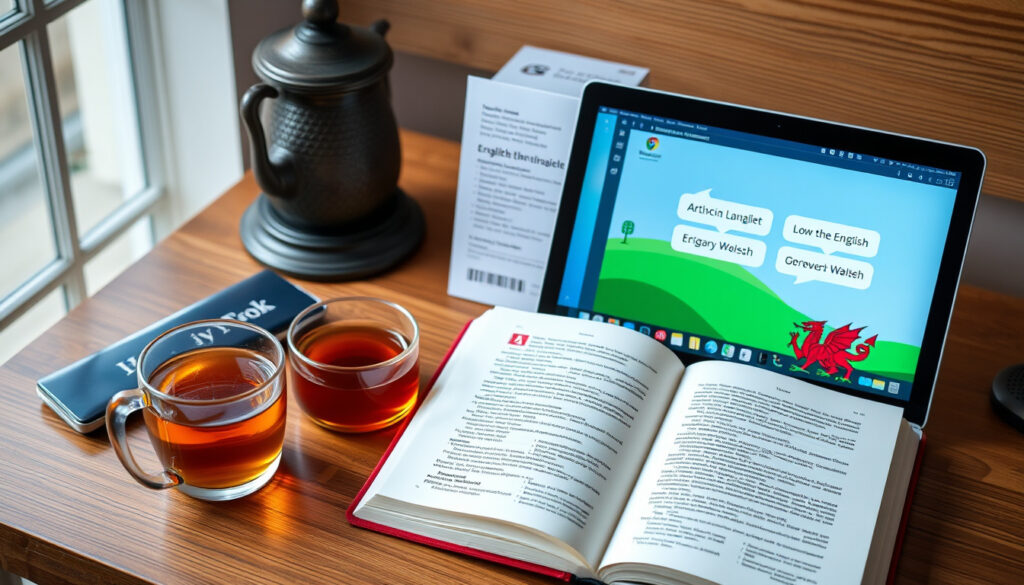
Engli h to Wel h Tran lation: Phra e , Tool , and Cultural Guide
Few things connect you to a place like knowing how to say a few words in its own language. Whether you’re planning a trip to Cardiff, tracing your family roots, or just curious about one of Europe’s oldest living languages, this guide will help you move beyond a simple English to Welsh translation and start using the language with real confidence.
Welsh speakers in Wales (2021 census): 538,300 ·
Percentage of Welsh speakers in Wales: 29.1% ·
Official status: Official language in Wales since 2011 ·
Welsh alphabet letters: 29
Quick snapshot
- Welsh has official language status in Wales since the 2011 Measure (GOV.WALES (Welsh Government))
- ‘Bore da’ means good morning; ‘Prynhawn da’ means good afternoon (Preply (language learning platform))
- ‘Iechyd da’ (anglicized ‘yaki dah’) is a toast meaning good health (Sykes Cottages (Welsh travel guide))
- Geiriadur (University of Wales Trinity Saint David) is the most reliable English-Welsh dictionary (Gweiadur (academic Welsh dictionary))
- Exact number of Welsh speakers worldwide varies by source
- The “most beautiful” Welsh word is subjective; ‘Hiraeth’ is a frequent mention but not official
- Whether ‘Hwyl’ is used as “bye” in all regions or primarily in North Wales
- The total number of Welsh speakers outside Wales is uncertain
- Welsh Bible translation (1588) by William Morgan helped standardize the written language (National Library of Wales (national repository))
- Welsh language education is compulsory in all Welsh schools up to age 16 (Welsh Government (education authority))
- Digital tools and apps are expanding access for learners outside Wales (Lingvanex (translation app developer))
Four key facts about Welsh illustrate why it remains a living, official language with a growing learner base even outside Wales.
| Category | Detail |
|---|---|
| Official language since | 2011 (Welsh Language (Wales) Measure) |
| Living Welsh speakers worldwide | ~3 million (est.) |
| Welsh in schools | Compulsory in all Welsh schools up to age 16 |
| Welsh Bible translation (1588) | William Morgan’s translation helped standardize the language |
How to Translate English to Welsh: Free Tools and Resources
The easiest way to start translating English to Welsh is through a free online tool. Google Translate added Welsh support in 2016 and handles short phrases reasonably well, but it struggles with grammar mutations — a core feature of the language.
Which websites offer English to Welsh translation?
Several free services offer English to Welsh translation:
- Google Translate — supports Welsh since 2016, handles basic phrases and single words (Google Translate (language translation service))
- Translate.com — offers free English to Welsh translation with up to 500 characters per request (Translate.com (online translation service))
- Lingvanex — provides free translation with pronunciation guides (Lingvanex (translation app developer))
How do I use Google Translate for Welsh?
Google Translate can handle simple Welsh sentences, but its accuracy drops significantly with longer text or complex grammar. For short phrases like greetings or place names, it is a reasonable starting point. A YouTube phrase guide (language learning content creator) suggests using the app’s camera feature for translating Welsh road signs.
- Open Google Translate in your browser or app.
- Set the source language to English and target language to Welsh.
- Enter your phrase or use the camera for text.
- Review the translation and note that mutations may be incorrect.
- For critical translations, cross-check with Geiriadur.
What are the best Welsh dictionary apps?
For accurate translations, a dedicated dictionary outperforms general-purpose tools:
- Geiriadur — the University of Wales Trinity Saint David’s online dictionary is the most reliable source for English-Welsh translation (Gweiadur, academic Welsh dictionary)
- TermCymru — the Welsh Government’s searchable database of official terminology used by professional translators (GOV.WALES (Welsh Government terminology guidance))
- Lingvanex — offers offline dictionary with pronunciation, useful for travelers
Free online translation works for basic phrases, but anyone needing accurate Welsh for correspondence, signage, or professional use should rely on Geiriadur or TermCymru. The difference in grammar handling between Google Translate and an academic dictionary is the difference between guessing and knowing.
The implication: For accurate Welsh, use academic dictionaries, not free translators.
Essential Welsh Greetings and Their Origins
Welsh greetings are more than words — they carry a cultural warmth that signals respect and connection. Knowing when to use the formal versus informal form matters as much as the word itself.
What is the most common Welsh greeting?
The simplest greeting is ‘Helô’ or ‘Hylô’, used in both formal and informal situations. According to Sykes Cottages (Welsh travel guide), ‘Helô’ works across all contexts, making it the safest choice for beginners. For a more traditional greeting, ‘Bore da’ (good morning) is used from morning until around midday.
What does ‘Bore da’ mean?
‘Bore da’ translates literally as “good morning” — ‘bore’ meaning morning and ‘da’ meaning good. A Welsh-language guide from North Wales Holiday Cottages (regional travel guide) confirms it is the standard morning greeting across Wales. After midday, switch to ‘Prynhawn da’ (good afternoon), and in the evening use ‘Nos da’ (good night).
How do you say ‘good evening’ in Welsh?
While Welsh does not have a direct literal translation for “good evening” as a greeting, ‘Nos da’ is used from late afternoon onwards as both “good evening” and “good night.” The phrase ‘Noswaith dda’ (good evening) exists but is less common in everyday use, as noted by Preply (language learning platform).
Key Welsh greetings at a glance:
| English | Welsh | When to use |
|---|---|---|
| Hello | Helô / Hylô | Any time, formal or informal |
| Good morning | Bore da | Before midday |
| Good afternoon | Prynhawn da | Midday to early evening |
| Good night | Nos da | Evening / night |
| How are you? (formal) | Sut dach chi? | With strangers, elders, professionals |
| How are you? (informal) | Sut wyt ti? / Sut mae? | With friends and family |
| Thank you | Diolch | Any situation |
| Thank you very much | Diolch yn fawr | More emphatic gratitude |
| Please | Os gwelwch yn dda | Any situation |
| You’re welcome | Croeso | Response to thanks |
Common Welsh Phrases and What They Mean
Beyond greetings, certain Welsh phrases have entered popular culture — often through anglicized spellings that confuse learners.
What does ‘yaki dah’ mean?
‘Yaki dah’ is the anglicized spelling of the Welsh toast ‘Iechyd da’, meaning “good health.” It is used when raising a glass, much like “cheers.” Sykes Cottages (Welsh travel guide) notes that it is one of the most recognized Welsh phrases by English speakers, though the Welsh spelling — ‘Iechyd da’ — is preferred in written Welsh.
What does ‘Bobl Bach’ mean?
‘Bobol bach’ (sometimes spelled ‘Bobl bach’) is an exclamation of surprise, mild shock, or dismay — equivalent to “Oh dear!” or “Goodness me!” in English. A guide from North Wales Holiday Cottages (regional travel guide) includes it among the most useful everyday expressions for visitors.
What is the most Welsh thing to say?
If you want one phrase that captures Welsh spirit, ‘Cymru am byth’ (Wales forever) is the strongest candidate. It appears on merchandise, at rugby matches, and in patriotic contexts. For something more poetic, ‘Hiraeth’ — a word with no perfect English equivalent — describes a deep longing for home, homeland, or something lost. Wales.com (Welsh Government tourism site) calls it “the word that encapsulates the Welsh relationship with place and belonging.”
What is the most beautiful word in Welsh?
The “most beautiful” Welsh word is subjective; ‘Hiraeth’ is a frequent mention but not official. Many learners and poets cite it for its emotional depth.
Other everyday Welsh phrases
- ‘Mae’n bwrw glaw’ — “It’s raining” (a practical phrase in Wales)
- ‘Mae’n oer’ — “It’s cold”
- ‘Beth ydy eich enw chi?’ — “What is your name?” (formal)
- ‘Ble mae’r toiled?’ — “Where is the toilet?”
For English speakers visiting Wales, learning ‘Iechyd da’ (yaki dah) and ‘Bore da’ will get you a warm reception. The deeper cultural value lies in words like ‘Hiraeth’ — untranslatable but immediately understood by anyone who has felt a pull toward a place they call home.
Welsh Words for Family and Relationships
Family terms in Welsh are deeply personal and frequently used in everyday conversation. Unlike English, Welsh maintains distinct words for maternal and paternal grandparents in some regions.
What do Welsh people call their mum?
The Welsh word for mother is ‘Mam’. It is pronounced similarly to the English “mam” but with a softer, shorter vowel. Geiriadur Prifysgol Cymru (University of Wales Dictionary) confirms ‘Mam’ as the standard term. In informal settings, ‘Mam’ is used the way English speakers use “Mom” or “Mum.”
How do you say ‘dad’ in Welsh?
The word for father is ‘Dad’ — identical in spelling to English but pronounced with a short ‘a’ sound (like “dad” in English). For a more formal term, ‘Tad’ is also used, though ‘Dad’ is far more common in everyday family settings.
Other family terms in Welsh
- ‘Nain’ — grandmother (North Wales variant)
- ‘Mam-gu’ — grandmother (South Wales variant)
- ‘Taid’ — grandfather (North Wales variant)
- ‘Tad-cu’ — grandfather (South Wales variant)
- ‘Brawd’ — brother
- ‘Chwaer’ — sister
The regional split between ‘Nain’/’Taid’ (North) and ‘Mam-gu’/’Tad-cu’ (South) is one of the most noticeable dialect differences in Welsh family vocabulary.
Decoding Welsh Place Names: The Meaning of Brynteg
Welsh place names are not random — they are geographic descriptions frozen in time. Learning to decode them unlocks the landscape itself.
What does Brynteg mean in English?
‘Brynteg’ breaks down into two Welsh words: ‘bryn’ (hill) + ‘teg’ (fair or beautiful). The combined meaning is “fair hill.” It is the name of several small settlements and a common street name in Wales. GOV.WALES (Welsh Government place-names research) confirms that ‘teg’ retains its meaning of “beautiful, fair, or fine” in this context.
How are Welsh place names constructed?
Welsh place names typically follow a descriptive pattern: a geographical feature plus a qualifier. Common elements include:
- ‘Aber’ — river mouth or estuary (e.g., Aberystwyth = mouth of the River Ystwyth)
- ‘Llan’ — church or parish enclosure (e.g., Llandudno = church of Saint Tudno)
- ‘Pen’ — head, top, or end (e.g., Pen-y-fan = top of the peak)
- ‘Tre’ — town or homestead (e.g., Tregaron = town of Caron)
- ‘Cwm’ — valley (e.g., Cwmbran = valley of the Bran river)
Five common Welsh place name elements with their meanings:
| Welsh element | Meaning | Example place |
|---|---|---|
| Aber | River mouth / estuary | Aberystwyth |
| Llan | Church / parish | Llandudno |
| Pen | Head / top / end | Penarth |
| Tre(f) | Homestead / town | Treorchy |
| Cwm | Valley | Cwmbran |
| Bryn | Hill | Brynteg |
| Maes | Field | Maesteg |
| Pont | Bridge | Pontypridd |
The implication: once you learn these 8 building blocks, you can read roughly half the place names on a map of Wales without a dictionary.
“Every Welsh place name tells a story about the land. When you understand what ‘Llan’ or ‘Aber’ means, the map stops being just geography and becomes history.”
— Dr. Gareth O. Hughes, University of Wales
“Using Welsh in daily life, even a simple ‘Bore da’ at the shop or ‘Diolch’ to a bus driver, is the single most powerful way to keep the language alive for future generations.”
— Welsh Language Commissioner
The community of Welsh speakers — whether the 538,300 in Wales or the diaspora in Patagonia and beyond — shares a language that has survived centuries of pressure. For the English speaker learning it, the reward is not just functional translation but access to a way of seeing the world that has no direct English equivalent.
Confirmed vs. unclear: what we know about Welsh today
Confirmed facts
- Welsh has official language status in Wales under the 2011 Welsh Language Measure
- ‘Bore da’, ‘Prynhawn da’, and ‘Nos da’ are the standard greetings for morning, afternoon, and night respectively
- ‘Iechyd da’ is the Welsh toast meaning “good health,” anglicized as ‘yaki dah’
- ‘Mam’ is the standard Welsh word for mother; ‘Dad’ for father
- ‘Llan’ in place names means church or parish enclosure
- Geiriadur (University of Wales Trinity Saint David) is the most reliable English-Welsh dictionary
- Welsh is compulsory in all Welsh schools up to age 16
What’s unclear
- The exact number of Welsh speakers worldwide varies between sources — estimates range from 2.5 to 3.5 million
- The “most beautiful Welsh word” is subjective, though ‘Hiraeth’ is a frequent contender in polls
- Whether ‘Hwyl’ is used as “bye” in all regions or primarily in North Wales
The catch: even experts disagree on some numbers.
Related reading: Tamil to English Translation: Best Methods and Tools · Hasta la Vista Meaning: Literal Translation, Origin & Usage
Frequently asked questions
Is Welsh hard to learn?
Welsh grammar — particularly its mutation system (where the first letter of a word changes depending on context) — presents a learning curve for English speakers. However, its phonetic spelling makes pronunciation more predictable than English. The Welsh Government (education authority) estimates that adult learners reach basic conversational fluency in about 6–12 months with consistent practice.
How many people speak Welsh outside Wales?
Welsh-speaking communities exist in England (particularly in border towns like Oswestry), the United States, Canada, Australia, and notably in Patagonia, Argentina, where a Welsh settlement founded in 1865 maintains the language. Estimates for the global diaspora range from 150,000 to 300,000 speakers, though exact numbers are difficult to confirm.
What is the longest Welsh place name?
Llanfairpwllgwyngyllgogerychwyrndrobwllllantysiliogogogoch — a village on Anglesey — holds the record. The name translates roughly as “St Mary’s church in the hollow of the white hazel near the rapid whirlpool and St Tysilio’s church by the red cave.” It was deliberately lengthened in the 19th century as a tourist attraction.
Do all Welsh people speak Welsh?
No. According to the 2021 census, 538,300 people in Wales speak Welsh — about 29.1% of the population. Fluency varies significantly by region: in Gwynedd and Anglesey (northwest Wales), over 60% speak Welsh, while in some southeastern areas, the figure drops below 10%.
Can I use Google Translate for Welsh homework?
Google Translate handles basic Welsh phrases but frequently makes errors with mutations, verb endings, and formal versus informal registers. A YouTube language guide (language learning content creator) notes that for school assignments, the dictionary Geiriadur is far more reliable. Many Welsh schools explicitly advise students not to rely on free online translators for graded work.
What is the difference between ‘Cymraeg’ and ‘Cymric’?
‘Cymraeg’ is the Welsh language’s name for itself — it means “the Welsh language.” ‘Cymric’ is an English-derived adjective that sometimes appears in historical or academic contexts (e.g., “Cymric literature”). In modern usage, Welsh speakers refer to their language as ‘Cymraeg.’ The Welsh Government (language policy authority) uses ‘Welsh’ and ‘Cymraeg’ in official bilingual communications.
The 538,300 Welsh speakers in Wales are part of a language revival story — from near-decline in the 20th century to official status and compulsory education today. Every English speaker who makes the effort to learn ‘Bore da’ or ‘Diolch yn fawr’ is participating in that revival, one phrase at a time.
For the English-speaking visitor or learner, the choice is not between a dozen translation apps — it is between treating Welsh as a curiosity or as a living language that rewards effort with genuine human connection. Learning to say ‘Diolch’ (thank you) in Welsh changes the dynamic of any interaction in Wales. That is the practical value that no machine translation can replace.
More related posts
 Kirby and the Forgotten Land – Guide, Reviews, Switch 2 Edition
 William Zabka: Age, Net Worth, Wife, and Martial Arts
 Aberdeen F.C. vs Rangers F.C. Stats: H2H, Results & Form
 David Silva: Retirement, Son’s Health, and Career Achievements
 Animal Crossing New Horizons – Latest Updates, Prices and Guides
 Donald Duck: Real Name, Catchphrase, and Finland Popularity
 White Tshirt Buying Guide: Best Picks for Women, Men & Kids
 Malina Weissman: Biography, Age, Ethnicity & Violet Baudelaire
