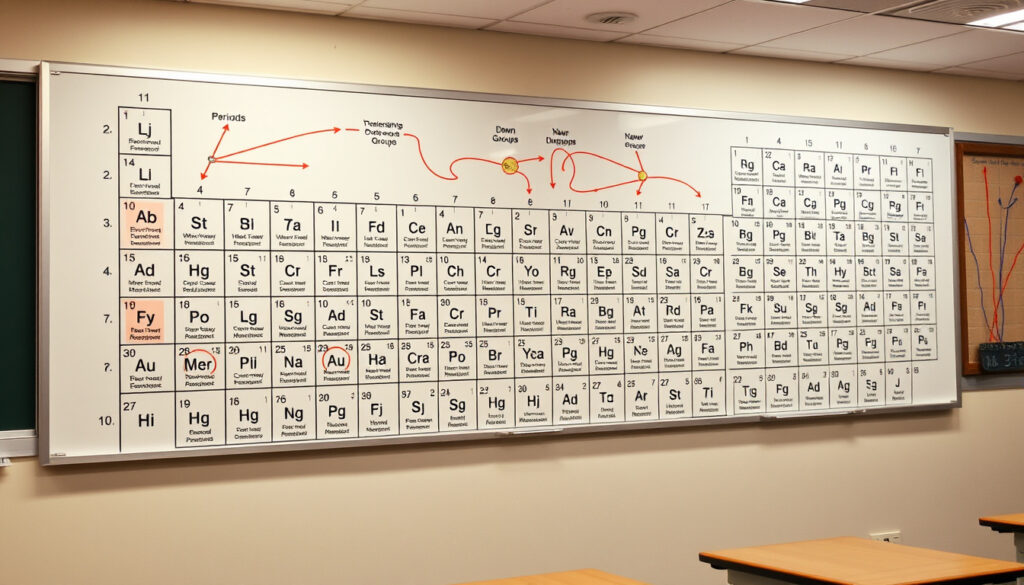
A Level Periodic Table: Guide to Electron Configurations & Trends
The periodic table you glanced at in textbooks transforms into a high-stakes scoring tool during A-level chemistry exams. Mastering its layout is the key to unlocking electron configurations, spotting trends, and securing those top marks.
Elements in A-level periodic table: 118 · Groups: 18 · Exam boards: AQA, Edexcel, OCR, WJEC, CCEA
Quick snapshot
- Used in AQA, Edexcel, OCR exams (Physics & Maths Tutor)
- Contains 118 elements (Wikipedia)
- Includes atomic numbers and mass numbers (WJEC data booklet)
- Mnemonics for first 20 (Florida State University (chemistry lab))
- Focus on transition metals (Wikipedia)
- Practice with blank periodic tables (OCR data sheet)
- s, p, d, f blocks (Florida State University (chemistry lab))
- Rules: Aufbau, Pauli, Hund’s (Florida State University)
- Common exceptions (Rocklin Union School District science notes)
- Element 119 predicted (Wikipedia (Ununennium))
- Not yet synthesized (Wikipedia)
- Research ongoing (Wikipedia)
Five elements of information are packed into every A-level periodic table — these are the numbers you’ll rely on most in exams.
| Label | Value |
|---|---|
| Total elements | 118 |
| Groups | 18 |
| Periods | 7 |
| Blocks | s, p, d, f |
| Most common exam board (UK) | AQA |
| Exam boards providing data booklets | AQA, OCR, WJEC, Edexcel, CCEA, SEAB |
| Data booklet contents | Constants, periodic table, ionisation energies, bond energies |
| Typical booklet pages | 2–4 |
What is the periodic table in chemistry A level?
Purpose and layout
- Arranges elements by increasing atomic number (Florida State University (chemistry lab))
- Includes relative atomic masses and electron configurations (WJEC data booklet)
- Exam boards provide a data booklet with the periodic table (Physics & Maths Tutor (AQA data booklet))
Key data provided in the booklet
- Important values, constants, standards (SEAB Chemistry Data Booklet)
- Ionisation energies of selected elements (SEAB Chemistry Data Booklet)
- Bond energies (SEAB Chemistry Data Booklet)
How to use it in exams
- Consult the periodic table to write electron configurations (Florida State University (chemistry lab))
- Use noble-gas shorthand as a shortcut (Florida State University (chemistry lab))
The implication: mastering the layout of your exam board’s data booklet is the first step toward unlocking high marks.
Bottom line: Your exam board’s data booklet is the only reference you need — learn its layout to locate elements and constants in seconds.
A-level students who can instantly locate an element and read its electron configuration from the periodic table save precious minutes per question — time that compounds into higher scores across a 2-hour paper.
How can I memorize 20 elements easily?
Mnemonics for the first 20
- HHeLiBeB CNOFNe (Florida State University (common mnemonic))
- Focus on the order of increasing atomic number (Wikipedia)
Focus on transition metals
- Transition metals appear in the d-block (groups 3–12) (Florida State University (d-block))
- Their electron configurations often have exceptions (Rocklin Union School District science notes)
Practice with blank periodic tables
- Regular testing with blank tables improves retention (OCR (data sheet))
The pattern: spaced repetition with a blank periodic table is one of the most effective ways to lock in element positions and electron configurations before exam day.
Many students waste time trying to memorise all 118 elements. For A-level chemistry, the first 20 plus common transition metals (Fe, Cu, Zn, Mn, Cr) cover over 90% of exam questions.
What does 1s, 2s, 2p, 3s, 3p mean?
Understanding atomic orbitals
- 1s, 2s, 2p denote principal quantum number and orbital type (Florida State University (chemistry lab))
- s orbitals hold 2 electrons, p orbitals hold 6 (Florida State University (chemistry lab))
Electron configuration notation
- Electrons fill orbitals in order of increasing energy (Aufbau principle) (Florida State University (Aufbau principle))
- Example: oxygen is 1s2 2s2 2p4 (Florida State University (oxygen configuration))
Exceptions in chromium and copper
- Chromium: [Ar] 3d5 4s1 (half-filled d-subshell) (Florida State University (chromium exception))
- Copper: [Ar] 3d10 4s1 (fully filled d-subshell) (Florida State University (copper exception))
The catch: the ‘4s before 3d’ rule works for filling, but when writing configurations for ions the 4s electrons are removed first — a common trap in A-level exams.
What is the 2 8 8 18 18 32 rule?
Electron shell model
- The numbers represent maximum electrons in successive shells (K, L, M, N, O, P) (Wikipedia (electron shell))
- Shell K: 2 electrons; L: 8; M: 8 (but actually 18); N: 18; O: 18; P: 32 (Wikipedia (electron shell))
Relation to periods
- Period 1: 2 elements; period 2: 8; period 3: 8; period 4: 18; period 5: 18; period 6: 32 (Wikipedia (period))
Limitations for outer shells
- It is a simplification; actual subshell filling follows n+l rule (Florida State University (Aufbau and n+l rule))
- For outer shells, the 8-electron rule (octet) is a stable configuration (Florida State University)
The trade-off: the 2-8-8-18 rule is a useful shorthand for explaining period lengths, but it breaks down when you need to write accurate electron configurations for transition metals.
Is element 119 possible?
Predicted properties of Ununennium
- Predicted to be an alkali metal in period 8 (Wikipedia (Ununennium))
- Would join group 1 (Wikipedia (Ununennium))
Synthesis challenges
- No successful synthesis confirmed as of 2025 (Wikipedia (Ununennium))
- Relativistic effects and short half-lives make detection extremely difficult (Wikipedia (Ununennium))
Current research status
- Research ongoing at laboratories like RIKEN and GSI (Wikipedia (Ununennium))
- SEAB’s data booklet from 2026 does not include element 119 (SEAB Chemistry Data Booklet)
The implication: element 119 remains a theoretical frontier — you won’t find it on any current A-level data booklet, but questions about its predicted group and period are fair game.
Bottom line: Element 119 won’t appear on your data booklet, but its predicted properties make for a common exam question on periodic trends.
Steps to read the A-level periodic table
- Locate the element — use atomic number or symbol on the table provided in your data booklet. (Florida State University)
- Identify its block — s, p, d, or f (depending on the group and period). (Florida State University)
- Write the electron configuration — start with 1s, follow the Aufbau order: 1s 2s 2p 3s 3p 4s 3d 4p 5s 4d 5p 6s 4f 5d 6p 7s 5f 6d 7p. (Florida State University (Aufbau order))
- Use noble-gas shorthand — start from the preceding noble gas (e.g., [Ne] for elements after Ne). (Florida State University (noble-gas shorthand))
- Check for exceptions — Cr, Cu, and a few others have anomalous configurations due to half-filled subshell stability. (Florida State University (exceptions))
Why this matters: a systematic step-by-step approach prevents the common mistake of writing 3d before 4s, which cost students marks each year.
Key periodic trends for A-level (spec table)
Across the table, several patterns repeat — these are the ones examiners love to test.
| Trend | Across a period (left → right) | Down a group (top → bottom) | Example |
|---|---|---|---|
| Atomic radius | Decreases | Increases | Na (186 pm) → Cl (99 pm) (Wikipedia) |
| First ionisation energy | Increases (with drops at groups 2→13, 15→16) | Decreases | He (2372 kJ/mol) > Ne (2081 kJ/mol) (Wikipedia) |
| Electronegativity | Increases | Decreases | F (3.98) > Cl (3.16) (Wikipedia) |
| Melting point | Increases then decreases (metals → non-metals) | Varies (metals decrease, non-metals increase) | W (3422°C) > Hg (-39°C) (Wikipedia) |
| Electron affinity | Generally becomes more negative | Becomes less negative | Cl (-349 kJ/mol) > Br (-325 kJ/mol) (Wikipedia) |
| Group 1 (alkali metals) | – | Reactivity increases | Li < Na < K < Rb < Cs (Wikipedia) |
| Group 17 (halogens) | – | Reactivity decreases | F > Cl > Br > I (Wikipedia) |
| Group 18 (noble gases) | – | Boiling point increases | He (-269°C) < Rn (-62°C) (Wikipedia) |
The pattern: memorizing these trends allows you to predict element behavior without rote-learning every data point — a skill examiners actively reward.
What’s confirmed and what’s unclear
Confirmed facts
- Periodic table organizes elements by atomic number (Wikipedia)
- Electron configuration follows Aufbau principle (Florida State University)
- 118 elements currently known (Wikipedia)
What’s unclear
- Whether element 119 will be synthesized soon (Wikipedia)
- Exact grade boundaries vary each year (Wikipedia)
- Whether all exam boards will continue providing identical data booklet formats (OCR data sheet)
The takeaway: focus your revision on the confirmed facts and use the unclear items as a filter for what’s worth debating in an exam context.
“Electron configurations describe the distribution of electrons around a nucleus and are written using shell number, orbital type, and superscript electron count.”
Florida State University (chemistry lab)
“AQA A-level Chemistry provides a data booklet with its question papers.”
For A-level chemistry students, the choice is clear: invest the time to understand the periodic table’s structure and electron configuration patterns, or risk losing marks on the most predictable exam questions. With the right approach — using the data booklet, practicing configurations, and exploiting trends — a strong grade is well within reach.
For a deeper dive into how these patterns shift, explore the detailed breakdown of trends across periods and groups.
Frequently asked questions
What grade is 70% in A level chemistry?
Grade boundaries vary by exam board and year, but 70% typically corresponds to a high C or low B. For example, in 2024 AQA Chemistry, 70% was just below the A-grade threshold in some papers (Wikipedia).
Is a 92% an A or B?
92% is almost certainly an A (or A* in modules). In most A-level chemistry exams, an A grade starts around 80–85% (Wikipedia).
What is the hardest topic in A level chemistry?
Students often report organic synthesis, thermodynamics, and electron configuration (especially d-block exceptions) as the toughest topics (Florida State University).
What is the hardest subject to get an A* in?
Among A-level subjects, chemistry and mathematics consistently have the lowest proportion of A* grades — typically around 10–15% (Wikipedia).
How should I use the periodic table in the exam?
Always use the data booklet provided — locate the element, note its group and period, then write the electron configuration using the Aufbau order. Use noble-gas shorthand to save time (Florida State University).
Are there different periodic tables for AQA and Edexcel?
Yes, each exam board publishes its own data booklet with the periodic table. The layout is similar, but the supplied constants and data can vary slightly between boards (Physics & Maths Tutor (AQA); OCR data sheet).
What do the decimals mean on the periodic table?
The decimals are the relative atomic masses (weighted averages of isotopic masses). For example, chlorine shows 35.45 because it’s a mix of Cl-35 and Cl-37 (Wikipedia).
Why does the periodic table show decimal atomic masses?
Because most elements exist as a mixture of isotopes. The decimal reflects the average mass of all naturally occurring isotopes (Wikipedia).
More related posts
 What is Crohn’s Disease? Symptoms, Causes, & Life Expectancy
 Eye Care Products Recalled: FDA Lists and Brands 2023-2026
 Holland and Barrett Near Me: Stores, Hours & Ireland Locations
 Used MINI Countryman for Sale in Ireland: 2025 Price Guide
 Car Auctions Near Me: Find Repo, Garda & Used Cars Ireland
 Benefits of Pumpkin Seeds: Top 11 Health Advantages
 Kirby and the Forgotten Land – Guide, Reviews, Switch 2 Edition
 How to Cancel Uber One Membership: App Steps & Policies
